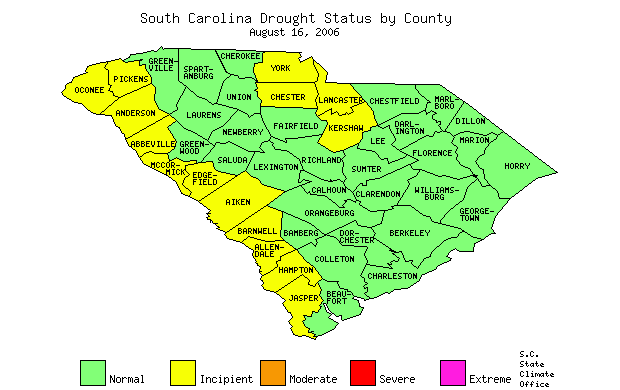
A pattern of sporadic rain showers and below-normal rainfall in some areas led the S.C. Department of Natural Resources to issue an incipient drought declaration for the entire Savannah River Basin and four counties in the Catawba/Wateree Basin.
On Wednesday, Aug. 16, in Columbia, after evaluating overall statewide conditions, the state agency members of the drought response committee voted to declare an incipient drought in all counties of the Savannah River Basin, including Oconee, Pickens, Anderson, Abbeville, McCormick, Edgefield, Aiken, Barnwell, Allendale, Hampton and Jasper, as well as York, Lancaster, Chester and Kershaw counties in the Catawba/Wateree Basin.
The incipient drought declaration is the first level of drought followed by moderate, severe and extreme. During incipient drought, the S.C. Department of Natural Resources (DNR) activates the Drought Information Center, increases monitoring and notification of the drought status. Water systems and industries are encouraged to closely monitor conditions and implement their drought plans as needed.
“The decision to upgrade the drought status to incipient was supported by the long-term rainfall deficit in the Upstate and headwaters of North Carolina,” said Freddy Vang, DNR deputy director of the Land, Water and Conservation Division. “Despite recent rains, the streams and lake levels along the Savannah and Catawba Wateree basins continue to decline.”
Mary Kathryn Green, spokesperson for Duke Energy said, “The rainfall totals we’ve seen for our area in the Carolinas, suggest conditions dryer this year than the same timeframe in 2002—which was the drought of record. Therefore we have reduced our hydro-generation by 45-percent to help conserve this resource. Duke Energy strongly supports the S.C. Drought Council’s decision to place the Savannah and Catawba/Wateree river basins under incipient drought conditions.”
Duke is at drought stage one as designated by its Low Inflow Protocol. On the Savannah, Lake Hartwell and Lake Thurmond have reached drought trigger level one and are close to drought level two, according to the U.S. Army Corps of Engineers Drought Plan.
According to Hope Mizzell, South Carolina state climatologist, the U.S Army Corps and Duke’s drought designations were major factors influencing the State Drought Response Committee’s decision to upgrade. Consistency between local, state and federal drought response is important for effective drought planning and management.
David Tompkins with the S.C. Department of Agriculture added that some areas are very dry, particularly in the Upstate and parts of the Coastal Plain. “While we don’t have a general agricultural drought at this time, we’re hoping for some good rainfall for the remainder of the growing season,” Tompkins said. Fortunately, according to David Baize with the S.C. Department of Health and Environmental Control, no water systems are reporting any supply problems at this time.
Darryl Jones with the S.C. Forestry Commission also reports that the ongoing dry weather in some areas of the state has forestry officials concerned about the potential long-term impacts to the state’s forests. While the number of forest fires and acres burned this year is close to the 10-year average, a continuation of the prolonged rainfall deficit could lead to an increase in the occurrence of wildfires, as well as other forest health concerns. While the effects of a long dry period are often not immediately noticeable, trees under stress from a lack of rainfall or water table fluctuation can become more susceptible to damage from bark beetles, defoliators, and saltwater influx into the soil.
If conditions continue to deteriorate, the DNR will convene the full drought response committee in the next few weeks.
                      Precipitation             Deviation
                         Total                  From Avg.
Greer                    20.42                    -12.0
Columbia                 22.55                     -9.6
Orangeburg               25.08                     -7.0
Charlotte, NC            23.70                     -3.6
Augusta, GA              23.02                     -6.3
Florence                 31.32                      2.2
Myrtle Beach             25.64                     -1.6
Charleston               28.47                     -4.0
Savannah, Ga             20.56                    -11.4
| Current Drought Status by County | ||||
|---|---|---|---|---|
| Normal | Incipient | Moderate | Severe | Extreme |
| County Status |
County Status |
County Status |
County Status |
County Status |
| ABBEVILLE Incipient |
AIKEN Incipient |
ALLENDALE Incipient |
ANDERSON Incipient | BAMBERG Normal |
| BARNWELL Incipient |
BEAUFORT Normal |
BERKELEY Normal |
CALHOUN Normal |
CHARLESTON Normal |
| CHEROKEE Normal |
CHESTER Incipient |
CHESTERFIELD Normal |
CLARENDON Normal |
COLLETON Normal |
| DARLINGTON Normal |
DILLON Normal |
DORCHESTER Normal |
EDGEFIELD Incipient |
FAIRFIELD Normal |
| FLORENCE Normal |
GEORGETOWN Normal |
GREENVILLE Normal |
GREENWOOD Normal |
HAMPTON Incipient |
| HORRY Normal |
JASPER Incipient |
KERSHAW Incipient |
LANCASTER Incipient |
LAURENS Normal |
| LEE Normal |
LEXINGTON Normal |
MARION Normal |
MARLBORO Normal |
MCCORMICK Incipient |
| NEWBERRY Normal |
OCONEE Incipient |
ORANGEBURG Normal |
PICKENS Incipient |
RICHLAND Normal |
| SALUDA Normal |
SPARTANBURG Normal |
SUMTER Normal |
UNION Normal |
WILLIAMSBURG Normal |
| YORK Incipient |
||||
Find out more about the State Climatology Office at https://www.dnr.sc.gov/climate/sco/ or by calling (803) 734-9100.
