For previously issued drought statements see the archived status reports.
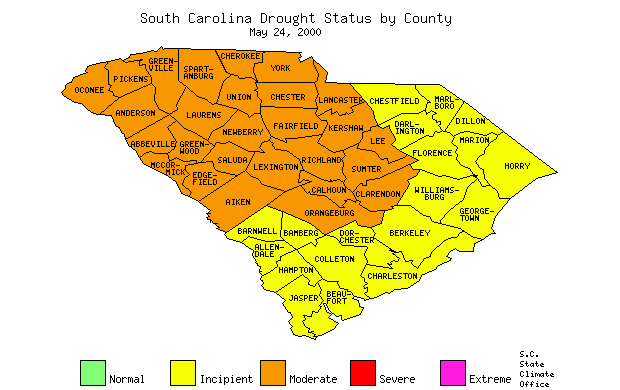
Table of all counties and drought status.The S.C. Department of Natural Resources has upgraded the drought status for all 46 counties with 27 now ranked "moderate," the second level, and the others "incipient,"the first level of drought.
An incipient drought declaration issued last year on October 21, was upgraded to "moderate" for Abbeville, Aiken, Anderson, Calhoun, Cherokee, Chester, Clarendon, Edgefield, Fairfield, Greenville, Greenwood, Kershaw, Lancaster, Laurens, Lee, Lexington, McCormick, Newberry, Oconee, Orangeburg, Pickens, Richland, Saluda, Spartanburg, Sumter, Union and York. A moderate drought declaration, the second of four drought levels specified in the Drought Response Act of 1985, means that drought conditions have continued to deteriorate and are expected to persist.
An "incipient drought," the first drought level, was declared for the remaining counties: Allendale, Bamberg, Barnwell, Beaufort, Berkeley, Charleston, Chesterfield, Colleton, Darlington, Dillon, Dorchester, Florence, Georgetown, Hampton, Horry, Jasper, Marion, Marlboro and Williamsburg.
According to the South Carolina Agricultural Statistics Service, fields across the state are in dire need of rain. Dry soils have stalled many planting operations. Fields that have been planted are showing little growth due to the dry soils. Corn is wilting in several areas. Soil moisture ratings across the state have declined to 29% very short, 62% short and 9% adequate.
Dale Linvill, agricultural meteorologist with Clemson University, explained that the maximum amount of available soil moisture (top 2 ft.) for South Carolina ranges from 11/2 to 3 inches. At present the moisture available for plants is less than 10% of these values.
South Carolina Forestry Commission spokesman Ken Cabe reported that as of May 24 wildfire occurrences are still fairly low, but control difficulties are increasing due to hot, dry conditions. Very intense burning observed on recent fires is causing significant damage to the affected forest. If the drought continues, lack of moisture alone is expected to take a toll on forest growth and vigor.
David Baize, Water Monitoring division director with the S.C. Department of Health and Environmental Control (DNR) reported that his agency has issued letters to all water system owners and dischargers requesting their attention to the drought conditions. The discharge of wastewater into low flowing streams should be regulated to avoid adverse impacts to the receiving streams, aquatic life and other stream uses.
Rod Cherry, hydrologist with the S.C. Department of Natural Resources (DNR), expressed his concern that water withdrawers who depend on wells or unregulated streams may experience water shortages and deteriorating water quality in the near future as water storage continues to decrease in the weeks ahead.
Both DNR and DHEC stress to the public and water suppliers that while water restrictions are not popular, early and effective use of voluntary restrictions may be necessary to protect water integrity and quality.
The Drought Response Committee encourages local water suppliers to implement drought response ordinances and plans for their area. Water suppliers are requested to send copies of any notice of voluntary or mandatory reductions to the Drought Information Center. The DNR will continue to monitor the situation and provide updates as needed. The public should contact the center at (803) 737-0800 for more information.
The DNR will continue to monitor the situation and provide updates as needed. Integrated drought information is available on the DNR's State Climatology Office Internet Web Site.
Contact Dr. Mizzell in Columbia at (803) 734-9568 or e-mail at mizzellh@dnr.sc.gov for more information.
DNR protects and manages South Carolina's natural resources by making wise and balanced decisions for the benefit of the state's natural resources and its people. Find out more about DNR at the DNR Web site.
| Current Drought Status by County | ||||
|---|---|---|---|---|
| Normal | Incipient | Moderate | Severe | Extreme |
| County Status |
County Status |
County Status |
County Status |
County Status |
| ABBEVILLE Moderate |
AIKEN Moderate |
ALLENDALE Incipient |
ANDERSON Moderate |
BAMBERG Incipient |
| BARNWELL Incipient |
BEAUFORT Incipient |
BERKELEY Incipient |
CALHOUN Moderate |
CHARLESTON Incipient |
| CHEROKEE Moderate |
CHESTER Moderate |
CHESTERFIELD Incipient |
CLARENDON Moderate |
COLLETON Incipient |
| DARLINGTON Incipient |
DILLON Incipient |
DORCHESTER Incipient |
EDGEFIELD Moderate |
FAIRFIELD Moderate |
| FLORENCE Incipient |
GEORGETOWN Incipient |
GREENVILLE Moderate |
GREENWOOD Moderate |
HAMPTON Incipient |
| HORRY Incipient |
JASPER Incipient |
KERSHAW Moderate |
LANCASTER Moderate |
LAURENS Moderate |
| LEE Moderate |
LEXINGTON Moderate |
MARION Incipient |
MARLBORO Incipient |
MCCORMICK Moderate |
| NEWBERRY Moderate |
OCONEE Moderate |
ORANGEBURG Moderate |
PICKENS Moderate |
RICHLAND Moderate |
| SALUDA Moderate |
SPARTANBURG Moderate |
SUMTER Moderate |
UNION Moderate |
WILLIAMSBURG Incipient |
| YORK Moderate |
||||
| SC Drought Response Committee Meeting, May 24, 2000 Sign-In sheet | |
|---|---|
| Name & Agency | Name & Agency |
Find out more about the State Climatology Office at https://www.dnr.sc.gov/climate/sco/ or by calling (803) 734-9100.
