For previously issued drought statements see the archived status reports.
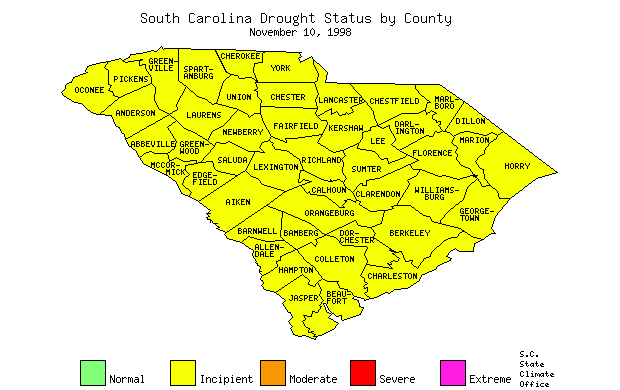
Table of all counties and drought status.On the basis of recent low precipitation totals statewide, declining soil moisture levels, and declining surface water flows, and under the authority of the S.C. Drought Response Act of 1985, the South Carolina Department of Natural Resources has issued an incipient drought declaration for the entire state.
At the incipient drought level, one of four levels defined in the legislation, the DNR increases its monitoring activities of drought-related variables such as precipitation, temperature, runoff, streamflow, evaporation, groundwater levels, soil moisture, reservoir levels, and other data. The DNR is also required to notify the affected areas and to serve as the primary agency to coordinate the State's response.
According to Dr. Michael Helfert, State Climatologist in the Department's Land, Water & Conservation Division, "The NOAA Climate Prediction Center (CPC) has issued climate outlooks that indicate that abnormally dry conditions will most likely persist through the winter and spring of 1998/99. The State Climatology Office is concerned about the impacts of this climate outlook for our rain-fed agricultural sector, forestry, and water storage providers. There is particular concern about the advisability of normal deep drawdowns of regional reservoirs this coming winter for seasonal cleaning and maintenance. The NOAA climate outlook for the forthcoming winter and spring is dependent upon the persistence of the 'moderate' La Nina cold phase in the Equatorial Pacific Ocean. Historical La Nina precipitation patterns should be a component in agricultural and hydrologic decision-making."
The State Climatology Office has reviewed the historical precipitation records for the 20th Century La Ninas to determine the lowest precipitation totals in the Southeast, state-by-state, during La Nina episodes. Most impacted by previous La Nina droughts have been Florida and South Carolina. In these two states, the five-month winter-spring rainfall "worst case" precipitation total during a severe La Nina is estimated to be as low as one-third of the normal. For South Carolina, records show that the most likely scenario for a forthcoming La Nina dry winter and spring is that the five months of December-April will have a precipitation total with a range of as great as 21.9" to as little as 12.75". The greatest probability, according to the guidance of the NOAA climate outlook, is for the lower range of 12.75" rather than the normal statewide average of just over 20" of rainfall for the December 1998 through April 1999 timeframe.
Complicating matters is that precipitation across the state has been suppressed since June 1998. If the influence of a few remnant tropical storms is subtracted from the 1998 summer and early autumn rainfall totals, South Carolina's rainfall would be minimal. At this time, most crops have completed their life cycle and harvests are being completed. One of the primary concerns is that soil moisture conditions are under 10% of normal capacity in large areas of the state. Additionally streamflows and reservoir/lake levels are already at very low levels following the minimal rains of September and October. These present low soil and surface water conditions should be of great concern as we are apparently in only the early stages of a reduced precipitation period.
The recent showers have brought little relief to this rainfall deficit. Statewide rainfall has averaged 55% of normal for the period October 1 - November 9, 1998. Rainfall deficits for specific areas of the state are as follows (see attached map): Allendale (50%), Anderson (30%), Columbia (9%), Charleston (55%), Florence (8%), Greenville-Spartanburg (62%), Myrtle Beach (63%), and Saluda (61%).
Lack of precipitation has produced dangerously dry forest fuel conditions throughout the Sandhill belt and Pee Dee of South Carolina. Conditions in the lower Coastal Plain are less severe, but fuels there are also unseasonably dry. "The fuel bed is ready to burn", said Ken Cabe, Fire Information Officer from the South Carolina Forestry Commission. "If we start getting wind the fire danger is going to escalate rapidly."
The National Weather Service 6-10 day outlook is for normal precipitation and below normal temperature. Mayors, county administrators, public service districts, and local water suppliers are asked to review their drought response plans and ordinances and notify the Department's Drought Information Center in Columbia if drought ordinances or plans are implemented, or if other related problems arise.
Contact Dr. Mizzell in Columbia at (803) 734-9568 or e-mail at mizzellh@dnr.sc.gov for more information.
DNR protects and manages South Carolina's natural resources by making wise and balanced decisions for the benefit of the state's natural resources and its people. Find out more about DNR at the DNR Web site.
| Current Drought Status by County | ||||
|---|---|---|---|---|
| Normal | Incipient | Moderate | Severe | Extreme |
| County Status |
County Status |
County Status |
County Status |
County Status |
| ABBEVILLE Incipient |
AIKEN Incipient |
ALLENDALE Incipient |
ANDERSON Incipient |
BAMBERG Incipient |
| BARNWELL Incipient |
BEAUFORT Incipient |
BERKELEY Incipient |
CALHOUN Incipient |
CHARLESTON Incipient |
| CHEROKEE Incipient |
CHESTER Incipient |
CHESTERFIELD Incipient |
CLARENDON Incipient |
COLLETON Incipient |
| DARLINGTON Incipient |
DILLON Incipient |
DORCHESTER Incipient |
EDGEFIELD Incipient |
FAIRFIELD Incipient |
| FLORENCE Incipient |
GEORGETOWN Incipient |
GREENVILLE Incipient |
GREENWOOD Incipient |
HAMPTON Incipient |
| HORRY Incipient |
JASPER Incipient |
KERSHAW Incipient |
LANCASTER Incipient |
LAURENS Incipient |
| LEE Incipient |
LEXINGTON Incipient |
MARION Incipient |
MARLBORO Incipient |
MCCORMICK Incipient |
| NEWBERRY Incipient |
OCONEE Incipient |
ORANGEBURG Incipient |
PICKENS Incipient |
RICHLAND Incipient |
| SALUDA Incipient |
SPARTANBURG Incipient |
SUMTER Incipient |
UNION Incipient |
WILLIAMSBURG Incipient |
| YORK Incipient |
||||
| SC Drought Response Committee Meeting, November 10, 1998 Sign-In sheet | |
|---|---|
| Name & Agency | Name & Agency |
Find out more about the State Climatology Office at https://www.dnr.sc.gov/climate/sco/ or by calling (803) 734-9100.
