For previously issued drought statements see the archived status reports.
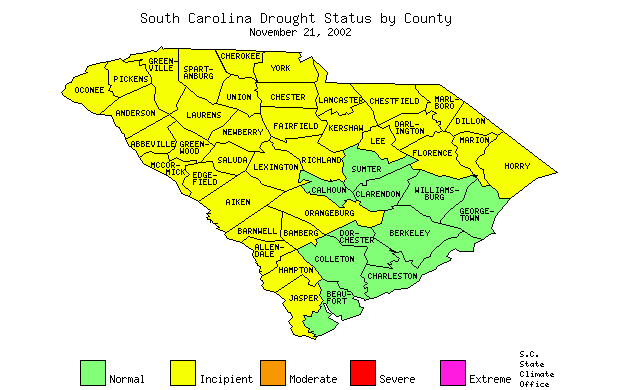
Table of all counties and drought status.The South Carolina Drought Response Committee met Thursday, November 21, in Columbia and downgraded the drought status in every county of the state.
"Much needed rainfall over the last two to three months alleviated the severe and Incipient drought conditions throughout the state," according to Freddy Vang, Deputy Director for the South Carolina Department of Natural Resources' Land, Water and Conservation Division. "Abundant precipitation has eliminated drought conditions altogether in ten counties located in the southern region and most of the Coastal Plain.".
Counties where the drought is over include Calhoun, Sumter, Clarendon, Williamsburg, Georgetown, Dorchester, Colleton, Beaufort, Charleston and Berkeley. All other counties, previously classified as either severe or extreme, were downgraded to incipient.
Counties now under an incipient drought classification include Oconee, Pickens, Greenville, Cherokee, York, Lancaster, Chesterfield, Marlboro, Dillon, Marion, Horry, Florence, Lee, Darlington, Kershaw, Fairfield, Richland, Lexington, Anderson, Bamberg, Newberry, Saluda, Greenwood, Union, Laurens, Chester, Spartanburg, Abbeville, McCormick, Edgefield, Aiken, Barnwell, Orangeburg, Allendale, Hampton and Jasper.
Vang added that even though the drought situation has improved, the consequences of drought continue. "The drought had a ripple effect throughout the state's economy," Vang said. "Our job now is to take lessons learned and apply that knowledge to minimize the negative effect of droughts in the future."
Hope Mizzell, SC Drought Response Program Coordinator, reported that the state has received much above normal rainfall since late August with many locations receiving 16 to 30 inches in less than three months. Mizzell emphasized that this is 5 to 15 inches above normal. "Some locations received the normal rainfall for a five-month period in just two and half months," Mizzell said.
Acting State Climatologist, Milt Brown, gave an optimistic forecast for above average rainfall and said that according to national models, the wet weather pattern is expected to continue throughout the winter and into early spring due to the influence of the El Nino event, on the global weather pattern.
Masaaki Kiuchi, DNR hydrologist stated that recent persistent, soaking rains brought stream-flows across the state back to normal for this time of the year, and in some cases, to higher than normal levels. Lakes and ponds are filling up much earlier than normal, except for the Savannah lakes. Groundwater levels are also recovering and in some areas reached the highest levels in two years.
Industry officials reported that increased streamflow levels will allow industry to slowly begin releasing effluent and lower wastewater holding pond levels that increased over the state's four-year drought period, but that normal rainfall throughout the winter is needed.
The prolonged drought period, especially over the past year, has severely impacted agriculture throughout the state, said Dale E. Linvill with the Agriculture Weather Office at Clemson University. "While it appears we're turning the corner, problems with shallow well water supplies and farm ponds continue." Linvill said. "Our hope is that the above average precipitation expected through the winter and into early spring will continue to supply much needed water for agricultural purposes."
Contact Dr. Mizzell in Columbia at (803) 734-9568 or e-mail at mizzellh@dnr.sc.gov for more information.
DNR protects and manages South Carolina's natural resources by making wise and balanced decisions for the benefit of the state's natural resources and its people. Find out more about DNR at the DNR Web site.
| Current Drought Status by County | ||||
|---|---|---|---|---|
| Normal | Incipient | Moderate | Severe | Extreme |
| County Status |
County Status |
County Status |
County Status |
County Status |
| ABBEVILLE Incipient |
AIKEN Incipient |
ALLENDALE Incipient |
ANDERSON Incipient |
BAMBERG Incipient |
| BARNWELL Incipient |
BEAUFORT Normal |
BERKELEY Normal |
CALHOUN Normal |
CHARLESTON Normal |
| CHEROKEE Incipient |
CHESTER Incipient |
CHESTERFIELD Incipient |
CLARENDON Normal |
COLLETON Normal |
| DARLINGTON Incipient |
DILLON Incipient |
DORCHESTER Normal |
EDGEFIELD Incipient |
FAIRFIELD Incipient |
| FLORENCE Incipient |
GEORGETOWN Normal |
GREENVILLE Incipient |
GREENWOOD Incipient |
HAMPTON Incipient |
| HORRY Incipient |
JASPER Incipient |
KERSHAW Incipient |
LANCASTER Incipient |
LAURENS Incipient |
| LEE Incipient |
LEXINGTON Incipient |
MARION Incipient |
MARLBORO Incipient |
MCCORMICK Incipient |
| NEWBERRY Incipient |
OCONEE Incipient |
ORANGEBURG Incipient |
PICKENS Incipient |
RICHLAND Incipient |
| SALUDA Incipient |
SPARTANBURG Incipient |
SUMTER Normal |
UNION Incipient |
WILLIAMSBURG Normal |
| YORK Incipient |
||||
| SC Drought Response Committee Meeting, November 21, 2002 Sign-In sheet | |
|---|---|
| Name & Agency | Name & Agency |
Find out more about the State Climatology Office at https://www.dnr.sc.gov/climate/sco/ or by calling (803) 734-9100.
