
Estuarine Condition Monitoring and Assessments
 South Carolina Estuarine and Coastal Assessment Program (SCECAP)
The Environmental Research Section at MRRI has conducted a number of monitoring studies throughout the last 40 years. Projects have included estuarine environmental quality monitoring, assessments of the impacts of coastal development on environmental quality, and monitoring pollution levels along the South Carolina coastline.
Estuarine Condition Monitoring
The current and longest running program is the South Carolina Estuarine and Coastal Assessment Program (SCECAP). The primary objective of SCECAP is to evaluate overall estuarine habitat quality and biotic condition over time and throughout the state's coastal zone in a manner that is integrated with and complementary to the SC Department of Health and Environmental Control (SCDHEC) Water Quality Monitoring Program. Sites are selected each year to represent both open water (rivers, bays and sounds) and large tidal creek habitats (important nursery areas) using sampling methods that permit us to quantify the percentage of each habitat type that meets, or does not meet, a desired level of quality. Approximately 30 sites are sampled each year to measure water quality, sediment quality, and biological condition. The thirteenth year of sampling for this program was completed in the summer of 2011, and the results of monitoring have been published in a series of biennial reports: 1999-2000, 2001-2002, 2003-2004, 2005-2006, 2007-2008, 2009-2010 (pending), 2011-2012 (sample collection/processing still in progress).
During the 2007-2008 survey period, approximately 90% of the state's coastal estuarine habitat (tidal creek and open water habitats combined) was in good condition. Only 4% of the coastal estuarine habitat was considered to be in poor condition and 6% in fair condition. When the two habitats were considered separately, a greater percentage of tidal creek habitat was in fair to poor condition (23% fair, 7% poor) as compared to open water habitat (3% fair, 3% poor). During the 2007-2008 study period, SCECAP stations with fair or poor habitat quality were concentrated primarily in the creeks and rivers that drain into St. Helena Sound, home to the Ashepoo-Combahee-Edisto (ACE) Basin, and in sites near the South Carolina/Georgia border. Rivers draining into the Charleston Harbor also historically show a persistent pattern of degraded habitat. Protection of these critical nursery habitats is vital to the sustainability of our fisheries and assessment studies to determine the causes of degraded habitat quality in these areas are currently underway by the SCDNR. A substantial portion of the current funding for this program is obtained from the USFWS with previous funding from the USEPA National Coastal Assessment Program. More information on the SCECAP program, including all biennial reports, is available at https://www.dnr.sc.gov/marine/scecap/
Program Coordinator:
Dr. Denise Sanger
Phone: 843-953-9074
Estuarine Assessments
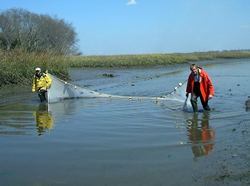 The Environmental Research Section has conducted a number of estuarine assessment studies through the years. The Tidal Creek Project was initiated back in 1994 and was expanded in 2005. The project is an ongoing cooperative project between the DNR and NOAA’s Hollings Marine Laboratory (HML) and Center for Coastal Environmental Health and Biomolecular Research (CCEHBR). The goal of project is to understand the linkage between coastal development (impervious cover as an indicator) of the land and the environmental and biological quality of tidal creeks and how these linkages change as you move downstream. Nineteen tidal creeks have been sampled in South Carolina, North Carolina, and Georgia as well as five tidal creeks in Alabama and Mississippi. A wide variety of parameters have been measured along the length of the creeks including salinity, dissolved oxygen, nutrients, bacterial pathogens, sediment chemical contaminants, and bottom dwelling and fish community samples. Tidal creeks have been found to be sentinel habitats that provide early warning of ensuing harm to the larger system (river, estuary). This is particularly true for the upper areas (headwaters) of tidal creeks. This study has found that when the amount of impervious cover (roofs, roads, parking lots) in coastal watersheds exceeds 10-30%, the physical, chemical, and biological processed in tidal creeks are impaired. In particular, the following changes were observed: increased fecal coliform levels, decreased sediment quality, changes in the kinds and abundances of bottom dwelling animals, changes in the abundance of juvenile fish, and decreases in the abundance of shrimp that use these habitats as nurseries.
Program Coordinator:
Dr. Denise Sanger
Phone: 843-953-9074