
Shellfish
Oyster Reef Ecology: Habitat Value
Oyster reefs are home to many estuarine and marine organisms. Those which remain on the reefs at low tide are referred to as "resident" species while those which only use the reefs at high tide are referred to as “transients”. As part of our oyster reef development study we sampled constructed oyster reefs quarterly to census residents and form a picture of how early developing oyster reefs are colonized.
Each quarter we also sampled nearby natural reefs in order to compare their resident populations. Samples were rinsed on a 1 mm mesh and all incidental organisms were collected for later identification.
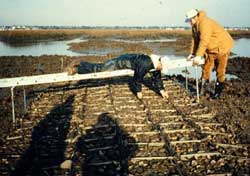
As oysters recruited to the constructed reef and began to form a more complex three dimensional habitat, the resident community also became more complex and started to resemble the populations on the natural reefs.
In terms of biomass, mussels, predominantly the ribbed mussel Geukensia demissa and the scorched mussel Brachiodontus exustus, are the second most abundant taxon after the oysters themselves.
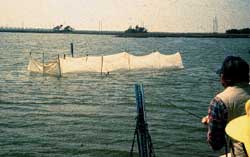
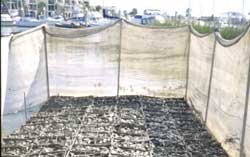
The constructed reefs were also used to study transient species. These include smaller individuals seeking refuge among the oysters and larger ones which find ample prey in the complex oyster reef community. Transient species were censused seasonally by surrounding each reef with a 24 m2 lift net. The net was raised on a high tide when transients are using the reef. When the tide retreated the visitors were trapped and collected.
 |
 |
Transient species which use oyster reefs include recreational and commercial species of fish. The table below lists some of the more frequent users of our reefs.
Transient Species on South Carolina Oyster Reefs
Finfish
| Common Name | Scientific Name |
|---|---|
| Spottailed bass | Sciaenops ocellatus |
| Gray snapper | Lutjanus griseus |
| Southern flounder | Paralichthys lethosti1!ma |
| Summer flounder | Paralichthys dentatus |
| Spot | Leiostomus xanthurus |
| Sheepshead | Archosargus probatocephalus |
| Darter goby | Gobionellus boleosoma |
| Naked goby | Gobiosoma bosc |
| Striped blenny | Chasmodes bosquianus |
| Striped mullet | Mugil cephalus |
| White mullet | Mugil curema |
| Oyster toadfish | Opsanus tau |
| Bay anchovy | Anchoa mitchilli |
| Strioed anchovy | Anchoa hepsetus |
| Mummichog | Fundulus heteroclitus |
| Atlantic silverside | Menidia menidia |
| Inland silverside | Menidia beryllina |
| Spotfin mojarra | Eucinostomus argenteus |
| Pinfish | Lagodon rhomboides |
| Silver perch | Bairdiella chrysoura |
| Pigfish | Orthopristis chrysoptera |
| Soeckled worm eel | Myrophis punctatus |
| Chain pipefish | Syngnathus louisianae |
Crustaceans
| Common Name | Scientific Name |
|---|---|
| Daggerblade grass shrimp | Palaemonetes pugio |
| Marsh grass shrimp | Palaemonetes vulgaris |
| Brown shrimp | Penaeus aztec us |
| White shrimp | Penaeus setiferus |
| Blue crab | Callinectes sapidus |
| Lesser blue crab | Callinectes similis |
Because of their dimensional complexity and the lack of seagrass beds in South Carolina, we expected oyster reefs to rank with salt marsh and seagrasses as important fish habitats. To demonstrate this, we used lift nets to sample for transients over mudflats and saltmarshes.
Oyster reefs attract a diversity and abundance of transient species similar to that found in saltmarsh. While mudflats generally support fewer species, they are not the barren wilderness we anticipated.