For previously issued drought statements see the archived status reports.
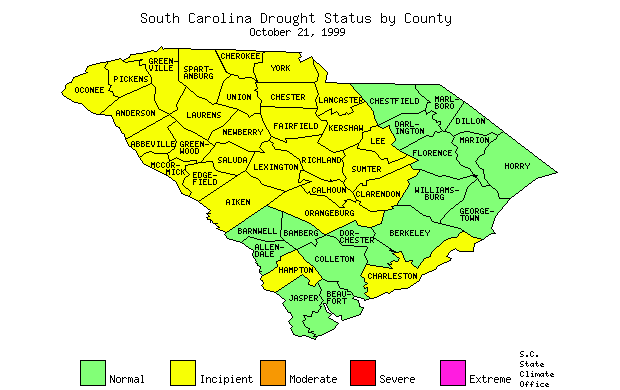
Table of all counties and drought status.South Carolina's drought has been downgraded for all counties. The State and Local Drought Response committees met Thursday, Oct. 21 in Columbia to discuss drought conditions across the state. The consensus of the group was that recent rains have been sufficient to relieve drought conditions statewide.
Hope Mizzell, state drought program coordinator, says only a few isolated locations are still experiencing a 12-14 inch rainfall deficit for the year. However, numerous locations are more than 9 inches below normal for the year despite the recent rains. Annual rainfall deficits include: Greenville/Sptbg. -11.6; Walhalla -12.8; Columbia -14.6; Johnston -11.4; Blackville -5.3; Allendale -7.1; Beaufort -2.6; Charleston -4.1; Myrtle Beach +11.9.
South Carolina Forestry Commission spokesman Ken Cabe says, "Recent rainfall has dampened surface fuels enough to reduce immediate wildfire danger. Frequent rain will be needed throughout the fall and winter months to keep fire occurrence at manageable levels."
Based on these considerations the committees unanimously voted to remove the drought declaration from Allendale, Bamberg, Barnwell, Beaufort, Berkeley, Chesterfield, Colleton, Darlington, Dorchester, Florence, Jasper, Marlboro and Williamsburg counties. Drought declarations for Dillon, Georgetown, Horry and Marion counties were lifted in September. The remaining counties in the Midlands and the Upstate were downgraded to incipient.
However, Dr. Michael Helfert, state climatologist says, "Recent rains may only provide temporary relief since all National Oceanic and Atmospheric Administration long-range climate models indicate drought conditions will return by November/December 1999 and possibly persist through March 2000. Decision-makers must consider the impacts of only receiving 60 percent to 80 percent of normal winter/spring rainfall through March 2000."
The DNR will continue to monitor the situation and provide updates as needed. Integrated drought information is available on the DNR's State Climatology Office Internet Web Site.
Contact Dr. Mizzell in Columbia at (803) 734-9568 or e-mail at mizzellh@dnr.sc.gov for more information.
DNR protects and manages South Carolina's natural resources by making wise and balanced decisions for the benefit of the state's natural resources and its people. Find out more about DNR at the DNR Web site.
| Current Drought Status by County | ||||
|---|---|---|---|---|
| Normal | Incipient | Moderate | Severe | Extreme |
| County Status |
County Status |
County Status |
County Status |
County Status |
| ABBEVILLE Incipient |
AIKEN Incipient |
ALLENDALE Normal |
ANDERSON Incipient |
BAMBERG Normal |
| BARNWELL Normal |
BEAUFORT Normal |
BERKELEY Normal |
CALHOUN Incipient |
CHARLESTON Incipient |
| CHEROKEE Incipient |
CHESTER Incipient |
CHESTERFIELD Normal |
CLARENDON Incipient |
COLLETON Normal |
| DARLINGTON Normal |
DILLON Normal |
DORCHESTER Normal |
EDGEFIELD Incipient |
FAIRFIELD Incipient |
| FLORENCE Normal |
GEORGETOWN Normal |
GREENVILLE Incipient |
GREENWOOD Incipient |
HAMPTON Incipient |
| HORRY Normal |
JASPER Normal |
KERSHAW Incipient |
LANCASTER Incipient |
LAURENS Incipient |
| LEE Incipient |
LEXINGTON Incipient |
MARION Normal |
MARLBORO Normal |
MCCORMICK Incipient |
| NEWBERRY Incipient |
OCONEE Incipient |
ORANGEBURG Incipient |
PICKENS Incipient |
RICHLAND Incipient |
| SALUDA Incipient |
SPARTANBURG Incipient |
SUMTER Incipient |
UNION Incipient |
WILLIAMSBURG Normal |
| YORK Incipient |
||||
| SC Drought Response Committee Meeting, October 21, 1999 Sign-In sheet | |
|---|---|
| Name & Agency | Name & Agency |
Find out more about the State Climatology Office at https://www.dnr.sc.gov/climate/sco/ or by calling (803) 734-9100.
