




SCDNR News
Brown Pelicans Return to Nest on Crab Bank; Closures Partly Extended to Protect Chicks
October 8, 2025
CHARLESTON, S.C. – For the first time since 2017, brown pelicans are nesting again on Crab Bank Seabird Sanctuary, prompting the South Carolina Department of Natural Resources (SCDNR) to extend seasonal closures on part of the island to protect vulnerable chicks.
Crab Bank, located at the mouth of Shem Creek, is one of South Carolina’s few nesting sites for colonial seabirds. Historically, between 1990s and the mid 2000s, the island has supported 10 to 20% of seabird nesting in the state. Years of wave and storm activity gradually reduced the size of the island, and with it, the available nesting habitat for birds. After Hurricane Irma in 2017, the island was flattened, leaving only an intertidal shoal unsuitable for nesting.
Conservation partners including SCDNR, the U.S. Army Corps of Engineers, conservation organizations, community members, and elected officials collaborated to save Crab Bank. In 2021, this joint effort was successful and the island was rebuilt using dredged material from the deepening of Charleston Harbor.
In the years following the restoration, American oystercatchers, black skimmers, least terns, and gull-billed terns were documented nesting on the island. This past July, SCDNR biologists counted 155 brown pelican nests, marking the first successful pelican nesting season on Crab Bank since its restoration. The return of brown pelicans underscores the success of Crab Bank’s restoration and highlights the power of community and partnership in conserving vital bird habitats.
"Following the restoration, the island was completely bare and lacked the vegetation pelicans rely on for nesting," said SCDNR Wildlife Biologist Janet Thibault. "But over the past year, shrubs and grasses have really started to take hold, and it's exciting to see pelicans using that new growth to build their nests and raise young on Crab Bank once again
While pelicans typically nest in the spring, the colony began nesting later this summer, which is expected when birds re-colonize a restored site. Because pelican chicks require about three months to become independent, many flightless chicks are still developing on the island past the usual breeding season.
"It is crucial for pelican chicks to have undisturbed areas to stretch their wings and cool down by the shoreline" said SCDNR biologist Cami Duquet. "Because they see people as threats, the chicks panic when someone gets too close and since they are not able to fly yet, they will try to flee into dangerous waves or currents. They might also regurgitate their last meal to escape faster, which may be their only food for the day."
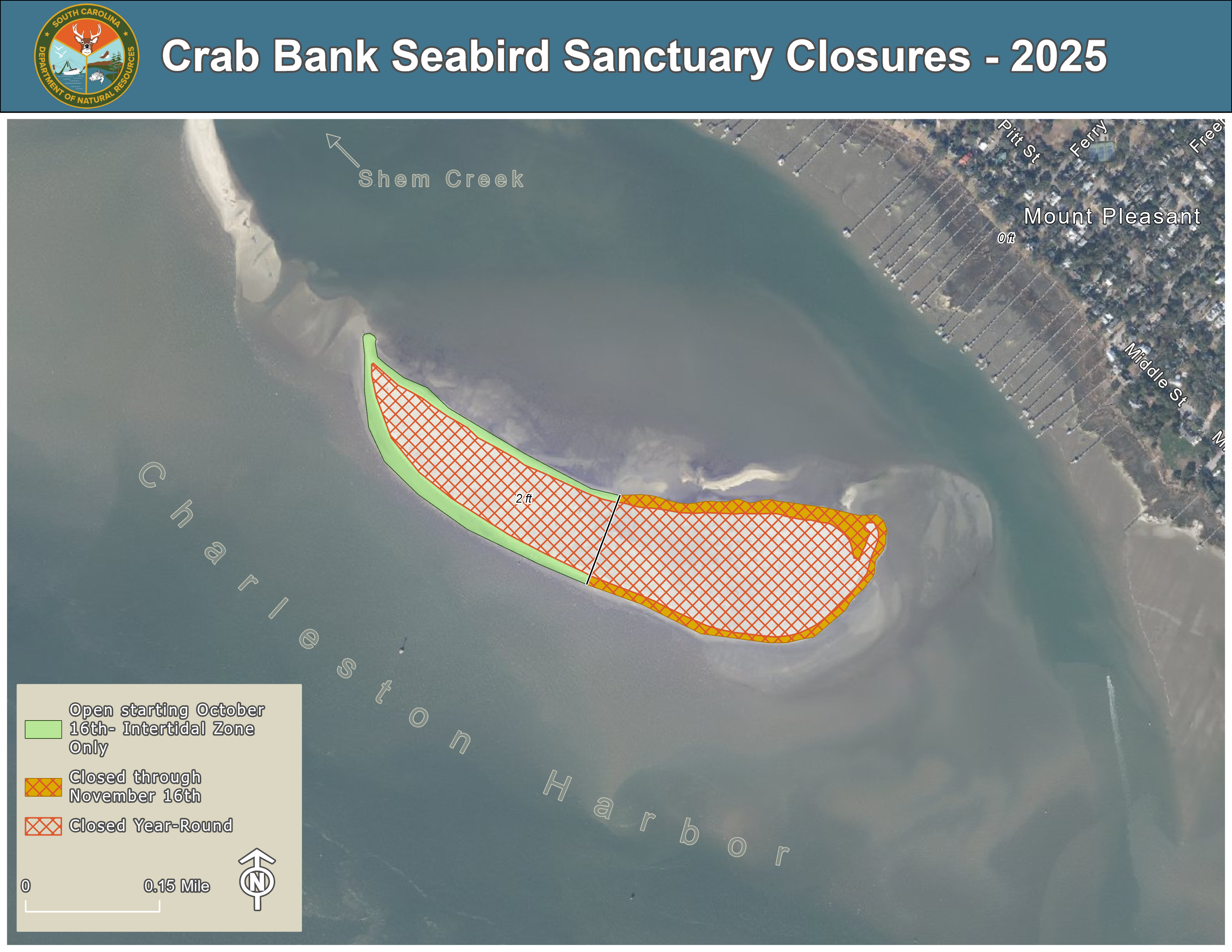
To protect these vulnerable chicks, SCDNR will extend the closure of the eastern end of Crab Bank beyond the standard reopening date of October 15. Beginning October 16, the western end of the island (intertidal zone only) will reopen for public access, while the eastern end will remain closed through November 15th. Closure boundaries will be marked with signs and buoys, visible at any tide.
The return of Brown Pelicans further highlights the collective success of Crab Bank’s restoration. SCDNR is grateful to the community and suite of partners that made this project possible through the Coastal Bird Conservation Fund and for the continued support of the management of the island for its shorebird and seabirds.