
Blue Crab
- Abundance and Predators
- Eating Habits
- Fishing Gear
- Glossary
- Growth and Molting
- Mating and Spawning
- Saltwater Fishing Conservation and Ethics
Despite its fearsome appearance and aggressive nature, the blue crab is greatly cherished in the South Carolina Lowcountry.
Gourmets prefer the blue crab's sweet meat over all other locally caught seafood. Recreational fishermen seek this easy to catch crab, which also supports a considerable commercial fishery.
Blue crabs require both inshore brackish waters and high salinity ocean waters to complete their life cycle. They range from Massachusetts to Texas, and occasionally north to Nova Scotia and south to Uruguay.
Chesapeake Bay, North Carolina, and Louisiana support the largest blue crab fisheries.
Although other small swimming crabs in this family (Portunidae) occur locally, only the blue crab has any commercial or recreational importance in South Carolina.
The blue crab's scientific name, Callinectes sapidus, translates to "savory beautiful swimmer."
Large males, called Jimmies by fishermen, have brilliant blue claws and legs. The mature females, or "sooks," have bright orange tips on their claws.
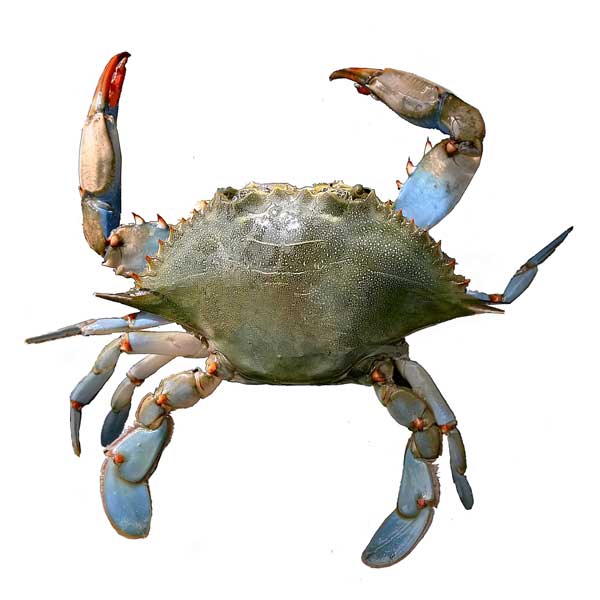
Males, larger than females, reach seven or eight inches, (sometimes up to ten inches) across the shell from point to point.
Males have a T-shaped abdomen held tightly against the underside of the body until maturity when it becomes somewhat free. The immature female has a triangle shaped abdomen tightly sealed against the body.
The mature female's abdomen becomes rounded and can be easily pulled away from the body after the final molt.
Blue crabs have five pairs of legs and can walk as well as swim. Three pairs of thin walking legs propel blue crabs sideways, as they clear a path with their sharp lateral spines.
Blue crabs swim by sculling the oar-like fifth pair of legs, the swimming legs. These paddles usually rotate at 20 to 40 revolutions per minute, but they quickly disappear into a blur as the animal darts away.
The large, powerful claws are used for food gathering, defense, digging and sexual displays. Blue crabs can inflict severe injury if not handled properly.
Growth and Molting
Blue crabs, like all other arthropods, must periodically shed their hard exoskeletons in order to grow.
The smallest crabs shed every three to five days, juvenile crabs every 10 to 14 days and those three inches and larger every 20 to 50 days.
Five to ten days before molting, a narrow white line appears just within the thin margin of the last two joints of the swimming legs.
A few days before shedding, these "peeler" crab's narrow white lines give way to a red line, and fine white wrinkles appear on the blue skin between the wrist and upper arm. Molting lasts for only a few minutes as the crab pushes out the rear of the old shell.
The resulting soft crab, limp and wrinkled, swells to normal shape and usually increases in size by 25 to 35%. If disturbed, the vulnerable soft shell crab can swim and walk but prefers seclusion.
After a few hours, the crab's shell becomes parchment-like and is fully hardened within two or three days.
In early April a "run" of peeler crabs usually lasts for about two weeks.
To attract females ready to mate, fishermen use "peeler pots," containing one or two large males. Peeler crabs are held in shedding tanks until they molt. The soft shell crabs are then removed from the water and refrigerated for sale and are generally in high demand for their delicious meat.
Mating and Spawning
Females mate only during the final molt when they are in the soft shell condition, but males are believed to mate several times.
Mating generally occurs in brackish water from February to November with peaks in March to July, and in October and November.
Two to three days prior to mating, the male cradle carries the soon-to-shed female after a rather elaborate courtship ritual. These crabs are called doublers.
The male, usually one to two inches larger than its mate, protects the soft female when she is vulnerable to predators. After mating, he will continue to carry her until her shell hardens.
Mated females migrate to higher salinity water in the lower reaches of the estuary or in the ocean. Spawning occurs in near-shore ocean water about one or two months after mating in spring or summer.
Females that mate in fall or winter usually spawn the following spring, producing up to two million eggs, but only one per million will survive to become an adult.
Eggs are carried under the abdomen until they hatch. The egg mass is bright orange at first and becomes darker as the embryos mature and consume the egg yolk.
Females carrying an egg mass are called sponge crabs, and are protected by law in South Carolina. If captured, they must be returned to the water immediately.
Sponge crabs usually first appear in early April and are common until August or September.
Eggs hatch into larvae after about two weeks. During the next month, larvae go through six or more stages before reaching the megalopal stage.
The megalopae, about 1/10- inch wide, migrate into the nutrient-rich salt marsh creeks, and soon transform into the "first crab" stage.
Crabs hatched in April or May become two to three inches wide by November and five inches or larger by summer the following year.
Crabs hatched in early fall will be only one or two inches in width by winter. After one year, these crabs will be approaching five inches wide.
A few crabs may live for three years, but most live for less than a year. South Carolina law requires that captured crabs less than five inches in width be returned to the water.
Abundance and Predators
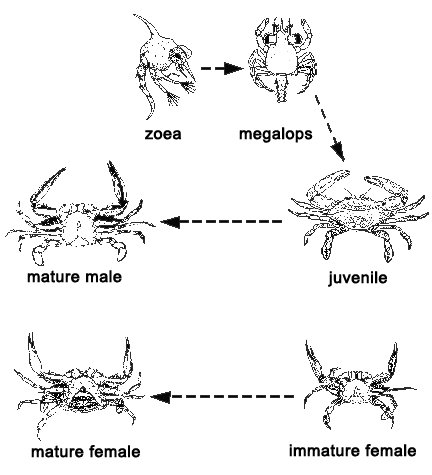
Life Cycle of Blue Crab - Starts as a zoea then grows into the
megalops which grows into the juvenile and finally the adult crab.
Many factors control year to- year variation in blue crab populations.
Water circulation patterns and wind can carry just-hatched larvae shoreward or sweep them into the deeper ocean where they cannot develop.
Young crabs that make it into the estuaries become vulnerable to drought, flood, or unseasonable temperatures.
Small crabs survive best during years of relatively high freshwater runoff, which increases nutrient input and decreases salinity. However, excessive rainfall can prematurely flush small crabs from the marsh.
Predators claim large numbers of young crabs, and crab populations may vary from year to year according to the abundance of predators.
Blue crabs are subject to predation throughout their life cycle particularly when molting. As larvae, they fall prey to fishes, jellyfish and other predators. The megalopae and juvenile crabs are consumed by various fishes and birds, as well as other blue crabs.
Megalopae and small crabs may be largely controlled by the coastal water currents and the weather. Young crabs within the estuaries are vulnerable to drought, flood, or unseasonable temperatures.
A relationship seems to exist between river discharge and survival of small crabs. Small crabs survive best during years of relatively high freshwater runoff, which increases nutrient input and decreases salinity. However, too much rainfall can also flush the small crabs from the marsh.
Predators claim large numbers of young crabs, and crab populations may vary from year to year according to the abundance of predators. Blue crabs are subject to predation throughout their life cycle and are particularly susceptible when they are soft during the molting process. As larvae, they are vulnerable to fishes, jellyfish and other planktivores. The megalopae and juvenile crabs are consumed by various fishes and birds, as well as other blue crabs.
Eating Habits
Crabs are opportunistic feeders, eating whatever is most available. They eat fishes, oysters, clams, snails, shrimp, worms and other crabs.
At high tide, crabs swim into the salt marsh to pluck snails from the tall grass. At other times, they burrow into the bottom with only their eye stalks visible, lying in wait for a passing meal.
Crabbers typically bait their pots with oily fishes to attract the crabs that detect the odor being released. Blue crabs can follow a current upstream by criss-crossing the stream bed.
Fishing Gear
The most common type of commercial fishing gear is the crab pot, which is a cubical wire trap with two or four entrance funnels.
The pot has two chambers: a lower chamber with entrance funnels and the bait well, and an upper chamber separated by a wire partition with two holes.
Blue crabs react to confinement by swimming upward, moving them into the upper chamber, thereby reducing their chances for escape.
The crab pot was first introduced in Chesapeake Bay in 1936 but was not widely used in South Carolina until the late 1950s.
Crabs are also caught and sold as part of the bycatch of shrimp trawlers, and after the shrimp trawling season is closed, usually in January, trawling for crabs with large mesh trawls is permitted until March 31.
Recreational blue crab fishermen use several different methods. State law allows individuals to fish two crab pots with only a recreational saltwater fishing license.
Pots must be properly marked with yellow floats bearing the owner’s name. Fishing more than two pots requires a commercial crabbing license. Recreational crab pots should have a marked float and enough line to prevent the float from being submerged at high tide.
Crabbers also not leave a pot where it would be exposed at low tide, and pots should be checked daily. Catches can often be doubled if the pots are checked twice per day.
Other recreational crabbing gear includes drop nets and dip nets. Drop nets and collapsible traps, usually baited with herring, can be fished from docks and bridges.
Dipping requires a long-handled dip net, several yards of string and bait, usually a chicken neck or fish head which is tied to the string and thrown into the water.
Once a tug is felt, the crabber pulls the bait and crabs close enough to be quickly dipped from the water and placed into a waiting bucket. Handle blue crab carefully, always approach from the rear when picking up a crab.
An experienced crabber can quickly grab the base of one of its swimming legs while holding down the claws.
Should a crab get a hold on a finger, it is usually best not to pull it off. First, try letting it hang; many times the crab will release and drop. If the crab will not release, use the free hand to immobilize the other claw and slowly bend the offending claw backward until the crab releases it.
Crabs can be caught all year, but become inactive, and therefore more difficult to catch in winter when water temperature falls below 50-55 degrees.
The best time of year to harvest large, heavy crabs is usually from October to December. Mature females are typically near the ocean, but large males are most common in the rivers and creeks.
Saltwater Fishing Conservation & Ethics
Ocean resources, once thought to be unlimited, have declined rapidly in recent decades, due in part to the overharvest of many commercial and recreational species of fish and shellfish.
To reduce overfishing, all anglers should practice wise conservation practices and adopt an ethical approach to fishing.
Size and catch limits, seasons and gear restrictions should be adhered to strictly. These regulations change from time to time as managers learn more about fish life histories and how to provide angling opportunities without depleting fish populations.
The challenge of catching, not killing, fish should provide anglers with the excitement and the reward of fishing. Undersized fish or fish over the limit should be released to ensure the future of fish populations.
More and more South Carolina fishermen now practice tag and release, which not only conserves resources but also provides information on growth and movement of fish.
Saltwater fishermen can further contribute to conservation by purchasing a Saltwater Recreational Fishing License, which is required to fish from a private boat or gather shellfish in South Carolina’s salt waters. Funds from the sale of licenses must be spent on programs that directly benefit saltwater fish, shellfish and fishermen.
Glossary
- Doubler
- A male crab carrying a female crab. Male blue crabs will carry a soon-to-molt female crab until she molts and is ready to mate.
- Jimmies
- Large adult male blue crabs
- Megalopae
- Final larval stage, between zoea and crab stage
- Molt
- Shedding of the exoskeleton
- Peeler Crab
- A crab that is about to molt. Fishermen catch peeler crabs, hold them until they molt, and then refrigerate for sale as soft shell crabs
- Sooks
- Mature female blue crabs
- Spawning
- Release of eggs and sperm
- Sponge Crab
- Female blue crab carrying an egg mass, which is bright to dark orange
This publication was made possible in part with funds from the sale of the South Carolina Saltwater Recreational Fishing License and the U.S. Fish and Wildlife Service Sportfish Restoration Fund. The South Carolina Department of Natural Resources publishes an annual Rules and Regulations booklet that lists all saltwater fishing regulations. Have an enjoyable fishing trip by reading these requirements before you fish.
Author credentials: J. David Whitaker, Marine Resources Division
The above information on the blue crab is available in a brochure, please download the Sea Science - Blue Crabs information pamphlet which is in the Adobe PDF file format. Adobe® Reader® is required to open the files and is available as a free download from the Adobe® Web site.