


Program Overview
 There
are over 30 nest protection projects along the coast of South Carolina with over 1100 participants.
They include a range of individuals, from paid federal and state
employees to projects that are run entirely by volunteers, usually
retirees living on resort islands. Some project members are also
involved with the Sea Turtle Stranding and Salvage Network (STSSN),
but the network also has members that are not associated with a nest
protection project.
There
are over 30 nest protection projects along the coast of South Carolina with over 1100 participants.
They include a range of individuals, from paid federal and state
employees to projects that are run entirely by volunteers, usually
retirees living on resort islands. Some project members are also
involved with the Sea Turtle Stranding and Salvage Network (STSSN),
but the network also has members that are not associated with a nest
protection project.
All individuals (except federal personnel at Cape Romain National Wildlife Refuge) are required to have state permits (which are renewed annually) in order to manipulate nests and handle stranded carcasses. This requires training by SCDNR staff both in the classroom and field, which covers the following activities:
- Beach patrol: The beach is surveyed each morning at dawn to locate loggerhead tracks in the sand where the turtle emerged to nest the previous evening. This is done by walking, use of an All Terrain Vehicle (ATV), or by a four-wheel drive pickup truck.
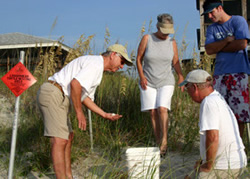
- Nest relocation/inventory: The egg chamber is located below the sand with a wooden dowel “probe stick”, a new egg chamber is constructed in a safer location, and the eggs are transferred to the new site. A post-emergence inventory involves counting the number of hatched eggs and dead or live hatchlings in the nest to calculate the percent hatchling emergence.
- Nest protection: This activity involves constructing predator-proof cages, screening nests, staking and marking nests, clearing away debris prior to hatching, removing heavily accreted sand from nests or from over screens, installing ghost crab traps, monitoring nests for predation, monitoring nests for emergence, and providing crowd control at emerging nests.
- Administration/organizational: This involves filling in application forms for a state permit, scheduling volunteer work times, summarizing year-end data for preparation of a final report to the state, as well as presenting public educational programs.
- Strandings: This involves the collection of biological data on sea turtle carcasses that wash ashore. The person must be able to correctly identify the species; interpret field signs for the presence of boat strikes, other human interactions, or shark wounds; and take accurate measurements of the carcasses.
Each year, there is an annual spring training workshop attended by the nest protection project leaders and any other volunteers that wish to attend. Guidelines are distributed and discussed. Printed materials, as well as slides and videos, are used as training aids. In addition, site visits are made to each project beach twice per season, once during the nesting season and again during the hatching season, to check out volunteers’ methodology and answer questions.


