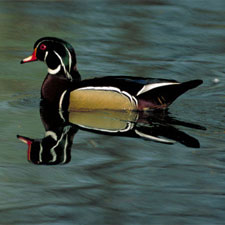
Wood Duck Box Construction
The wood duck often is referred to as the “Summer Duck.” As a resident, it is one of only a few of the waterfowl reproducing in the Palmetto State. Wood ducks are cavity nesters preferring natural holes or “hollows” in older trees more common in mature forested wetlands. Wood ducks readily adapt to man-made nest boxes where natural cavities may be limited or lacking. Construction of nest boxes and erection of nest box units can be an enjoyable and rewarding experience for anyone interested in a hands-on waterfowl conservation project. Do not build or erect a wood duck nest box unless it will be protected from predators and placed in or adjacent to a suitable permanent water site. Poorly erected and seldom maintained nest boxes only invite wood ducks away from secretive natural cavities to where predators will destroy eggs, kill the nesting hen or both. The all important conical guard placed below the nest box will protect it from climbing racoons, rat snakes and other predators. Trim low, overhanging limbs or nearby small trees within 48" of the nest box to prevent the overhead approach of predators. It is best to erect nest boxes in the shallow, permanent water of a marsh or pond having a good mix of open water and emergent plant cover. An adequate amount of interspersed wetland vegetation will provide both escape cover and habitat where ducklings will be able to forage for aquatic insects necessary for growth and development. Mount nest boxes on poles having a height of 52" to 60" above highest seasonal water levels. Space nest box units such that it will be difficult to see one nest box from another either using distance or concealing vegetation. Never mount 2 nest boxes back-to- back in a “piggy-back” fashion. This practice encourages competition for nest boxes and leads to dump nesting. Dump nesting, a product of density strife, is the result of more than 1 hen using a single box and laying at least 18 and up to 50 or more eggs. Dump nesting drastically lowers potential productivity. Remember, the wood duck is not a colonial nesting species, wood ducks evolved as solitary nesters in forested wetlands where natural cavities were widely scattered. Nest box projects, therefore, should mimic nature.
Start with a few boxes initially and increase as local populations grow remembering not to over-saturate. It may take several years before the first box is used, or it may be used immediately. The best time to erect nest boxes is December through February. Nest boxes preferably should be erected on wooden poles. Poles can be driven with a sledge hammer into soft, muck soil in most marshes or ponds. Posthole diggers work well, even underwater, in hard or clay soil. Be certain each post is securely set so it will bear the nest box. A submerged box containing a clutch of eggs defeats all conservation efforts. Wood ducks do not carry any nesting material into the nest. Place 3" of wood shavings in the box to insulate the nest. Rough sawn, cypress lumber is the best choice as a nest box building material. If smooth or dressed lumber is used, be sure to tack a piece of mesh screening to the inside under the entrance hole. This will enable day-old ducklings to climb up and exit with the brood when the hen calls from the water below. All nest boxes should be checked each winter prior to the nesting season to replace nesting material, check the tightness of the predator guard and secure the lid and screen door latch. Production inspections should be made as often as possible during March through June, but at least once in April or May. How to build a Wood Duck nest box Materials required for one box:
Assembly of box:
Predator guards are made from galvanized metal sheets available from any sheet metal shop. Drill 5/16" holes in sheet for 1/4" stove bolts or rivets to secure in a conical shape. Walt Rhodes Project Supervisor You can download and print the information on the Construction of Wood Duck Boxes which is in the Adobe PDF file format. Adobe® Reader® is required to open the files and is available as a free download from the Adobe® Web site.
|
||||||
|
South Carolina Department of Natural Resources - Phone Numbers | Accessibility Rembert C. Dennis Building, 1000 Assembly Street, Columbia, SC 29201 © 2005, 2006 All rights reserved. webmaster@dnr.sc.gov |