
Shellfish
Oyster Restoration
Oyster populations are on the decline worldwide due to a variety of causes including over-harvesting, lack of husbandry, declining water quality, loss of habitat, increased run-off, and erosion. In the Chesapeake Bay oyster populations represent less than 1% of the historic resource. In South Carolina we are pro-actively managing, restoring and enhancing oyster habitat to prevent losses of this severity.
The SCDNR conducts both large-scale and small-scale, community-based oyster restoration using recycled oyster shell. In order to maximize our restoration efforts, we have been studying reef development, evaluating alternative restoration methodology, and developing metrics for evaluating restoration success.
Oyster Restoration Methods
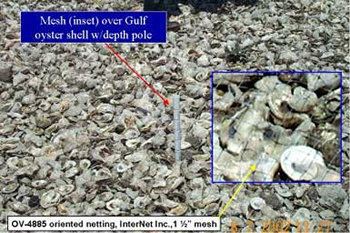 Studies in South Carolina have demonstrated that oyster populations are substrate-limited. Oyster larvae are abundant but there is a lack of hard substrate for attachment. Therefore oyster restoration is largely a matter of increasing the amount of hard substrate. Oyster shells provide the best substrate for juvenile oyster attachment, so restoration has traditionally relied on replanting oyster shells. Two problems currently face resource managers:
- Oyster shell is becoming increasingly scarce as more states initiate restoration efforts and
- Traditional restoration and management methods are not as effective as in the past. In recent years, shell planting has often failed to rejuvenate an area. Reasons for these failures vary but include rapid siltation and loss of shell due to boat wakes (link to wakes).
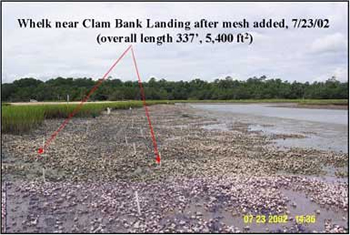
SCDNR is investigating alternative methods of restoring oyster reefs. Possibilities we are studying include:
- Changing the time at which shell is planted
- Using alternative substrates (other than shell)
- Covering shell with mesh to stabilize it against boat wakes
- Placing shell in mesh bags to stabilize it and create 3-D structure
- Placing geotextiles under the shell to reduce sinking
We are also investigating differences among sites which affect the success of shell planting so that we can improve restoration success by refining site selection.
Oyster Restoration: Large-Scale
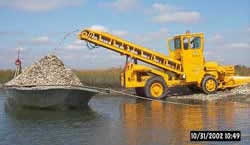
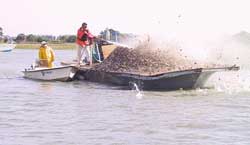
SCDNR uses proceeds from the Saltwater Fishing License to plant oyster shell on state-managed grounds. From 2002-2004, just under 280,000 ft2 (or 6.4 acres) of new oyster and whelk shell (total of 88,000 bushels) was planted to establish or enhance oyster habitat at 15 sites across the state. In 2005, additional funding was received from NMFS, allowing SCDNR to increase the acreage planted and to plant in areas other than Public Oyster Grounds. To improve our understanding of how best to restore oysters, we have been evaluating these sites to determine:
- Shell loss
- Siltation rates
- Erosion rates
- Oyster recruitment
- Oyster growth