
Shellfish
Oyster Reef Ecology: Reef Development
Oysters are an important component of the coastal ecosystem. In South Carolina, most oysters occur intertidally (exposed at low tide), forming extensive "reefs".
Previous funding for research in this area has included SC Sea Grant support to construct experimental oyster reefs to study reef development and determine functional characteristics of this critical habitat.
Elements of this multi-year study included:
- Site Characterization:
- Environmental parameters: Chlorophyll a, dissolved oxygen, pH, sedimentation rate, salinity,temperature (intertidal and subtidal)
- Contaminants (sediments and selected animal tissues)
- Oyster Life History Study
- Recruitment, growth and mortality of oysters
- Animals as habitat quality indicators
- Oyster diseases (Dermo and MSX)
- Resident and Transient Fauna Study
- Community parameters (species richness, similarity, evenness, etc.)
- Fauna reef progression through time
- Convergence of experimental and natural reefs
- Interactions between fauna, oysters and environmental conditions
- Adjacent Habitat Study
- Mudflat and marsh grass habitats comparisons
- Community parameters
- Similarity among three habitats
Intertidal oysters often occur along the shorelines of tidal creeks where they are referred to as ”fringing” reefs. Fringing reefs serve as natural breakwaters to reduce shoreline erosion.
Shoreline erosion may be caused by a number of factors including tidal flow, wind-driven waves, upland runoff and boat traffic. As coastal development increases, so does recreational boating. Wakes from motorboats and jet-skis have the potential to cause shoreline erosion, especially in narrow tidal creeks. SCDNR has been studying the effects of boat wakes (link to wakes) on oyster populations and adjacent saltmarsh.
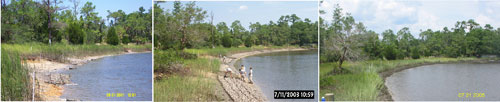
SCDNR is also examining relationships between oyster reefs and adjacent shorelines and whether erosion can be ameliorated by creating reefs in front of eroding shoreline. Erosion has been measured for varying periods of time (6 to 70 months) at 15 intertidal sites. Rates of erosion ranged from ½ inch to 2 inches per month. At several sites where reefs have been constructed, we have documented marsh re-growth after as little as two to three years. At one site, marsh has grown forward an average of twelve feet over a four-year period.
Peter Kingsley-Smith, Ph.D.
Associate Marine Scientist
South Carolina Department of Natural Resources
Marine Resources Research Institute
217 Ft. Johnson Road / PO Box 12559
Charleston, SC 29422-2559
Phone: (843) 953-9840
Fax: (843) 953-9820