



Leatherback Sea Turtles (Dermochelys coriacea)
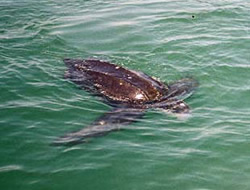 The
leatherback sea turtle is very different from other sea turtles having
seven hard longitudinal ridges along the length of its back instead
of scutes. Its rubber like covering is black with white spots and
a pinkish-white spot on the head. The average length of its shell
is five feet. The leatherback is listed as an endangered species.
Leatherbacks
are among the largest reptiles in the world, with adults commonly exceeding
1,000 pounds. The largest leatherback was over 2,000 pounds. Their
geographic distribution is the most extensive of any reptile.
Studies using satellite transmitters have shown the ability of these turtle
to cross entire ocean basins. Leatherbacks typically occur at low densities in the open ocean and therefore
are difficult to study in the wild. There is little information on leatherbacks
in captivity because they abrade their skin by continuously colliding with
the walls of holding facilities. Most leatherback studies involve nesting females
that can be accessed on the beach. Nesting beaches for the leatherback in the
western Atlantic are Costa Rica, French Guinea, Panama, Surinam, Central/South
America, south Florida and many islands in the Caribbean, especially Trinidad.
Nesting in South Carolina is rare to infrequent.
The
leatherback sea turtle is very different from other sea turtles having
seven hard longitudinal ridges along the length of its back instead
of scutes. Its rubber like covering is black with white spots and
a pinkish-white spot on the head. The average length of its shell
is five feet. The leatherback is listed as an endangered species.
Leatherbacks
are among the largest reptiles in the world, with adults commonly exceeding
1,000 pounds. The largest leatherback was over 2,000 pounds. Their
geographic distribution is the most extensive of any reptile.
Studies using satellite transmitters have shown the ability of these turtle
to cross entire ocean basins. Leatherbacks typically occur at low densities in the open ocean and therefore
are difficult to study in the wild. There is little information on leatherbacks
in captivity because they abrade their skin by continuously colliding with
the walls of holding facilities. Most leatherback studies involve nesting females
that can be accessed on the beach. Nesting beaches for the leatherback in the
western Atlantic are Costa Rica, French Guinea, Panama, Surinam, Central/South
America, south Florida and many islands in the Caribbean, especially Trinidad.
Nesting in South Carolina is rare to infrequent.
Prior to the late 1980’s, leatherbacks were rare visitors to South Carolina coastal waters. Since that time, leatherbacks have become a common visitor throughout state waters during spring. Leatherbacks are frequently seen feeding on cannonball jellyfish that are abundant at that time of year. A smaller secondary peak in abundance occurs in the fall. This abundance has created a rare opportunity to observe adult and immature, male and female leatherbacks in our nearshore waters.
The South Carolina Department of Natural Resources conducted aerial surveys to document the distribution and abundance of leatherbacks from 1993 - 2007. During these flights, we have observed more than 1,000 leatherbacks. We have also examined dead leatherbacks that strand along our coast. From these animals we can document sex and reproductive status, food habits and sometimes cause of death. These flights are restricted in number and can’t be flown over all areas or at all times of the year. In order to obtain more information on this endangered species we are requesting sighting information from the boating public. If you see a leatherback, please fill out our leatherback sighting form.
For a more comprehensive review, please read the Leatherback Sea Turtle Conservation Sheet. Also see our publication on leatherbacks in Chelonian Conservation Biology.
Leatherback sea turtle Recovery Plan
Leatherback nesting facts:
- Nesting: March - July
- Adult females are on average 155 cm curved carapace length (range 137 - 176 cm)
- A single female lays her nests relatively close (w/n 1 km); some lay nests 100 km apart
- Nocturnal nesters, symmetrical crawl
- Mean number of clutches per season 6.17, observed maximum is 11 nests
- Internesting interval: 9-10 days
- Remigration interval: 2-3 years
- Width of Crawl = 150+ cm
- Mean sizes of eggs are 5.3 cm in diameter, 75 g in mass and 80 cc in volume
- Mean clutch count for all eggs including spacers is 116
- Mean clutch count of yolked eggs is 81.5
- Mean incubation duration is 63 days but ranges from 55 – 75 days
- In situ hatch success is 55%
- Function of spacer, yolkless eggs is unclear


