


Post-nesting Loggerhead Telemetry
 View these loggerheads on the Project Web Site
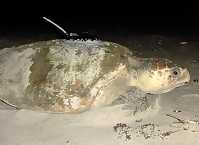
The beach selected for this study was Cape Island in the Cape Romain National Wildlife Refuge. Fifteen post-nesting loggerheads were tagged with satellite transmitters (five in 1998, 5 in 2002 and five in 2003). Cape Island is nine km long and is located at 33.02 degrees north and by 79.21 degrees west. It is the most significant loggerhead nesting beach north of Cape Canaveral, Florida with an average of 1,000 nests per season. The uninhabited beach is steep with coarse sand. Satellite transmitters were attached to 15 adult female post-nesting loggerheads. Back pack transmitters weigh approximately 800 grams and represent less than 3% of the turtle's body weight. The carapace is prepared for the attachment of the transmitter by removing barnacles and other organisms. A roll of Sonic Weld© is placed around the bottom edge of the transmitter and then Fast Foil epoxy is applied to the entire bottom surface with a glue gun. The transmitter is placed on the second vertebral scute and allowed to harden for 20 minutes. The turtle is then released to the ocean. Transmitters are linked to the Argos satellite system consisting of four satellites in polar orbit. Location data as well as transmitter temperature were received daily via email. Duty cycles varied with a majority of the transmitters “continuously on”. However, a salt-water switch sensor turned the units off when underwater, increasing potential data collection given that loggerheads remain submerged about 90% of each day. Although these transmitters could theoretically last for three years, data collection for more than a year was rare, most likely due to physical damage to the transmitters and/or biological fouling of the salt-water switch sensor. Despite these operational set backs, a tremendous amount of insightful data has been collected. With minimum transmitter failure, the non-nesting seasonal movements and habitat use of adult female loggerheads were documented. This research was funded in part with a grant from the National Marine Fisheries Service under Section 6 of the Endangered Species Act .
Follow these links to learn about other loggerhead satellite telemetry projects in SC:
Juveniles ~ Adult Males ~ Rehab


