
Common Aquatic Plant Management Problems
Please note:
This information is intended for educational purposes only. References to commercial
products or trade names are made with the understanding that no discrimination is intended of
other products which may be available. Any herbicides recommended herein for the treatment
of aquatic vegetation have been registered by the Environmental Protection Agency for use
in the manner described. The registration and use of a particular product may change
therefore the information provided here may not remain current indefinitely. It is the
responsibility of the user to read and follow the manufacturer's label to prevent misuse
of the product.
Alligator Weed
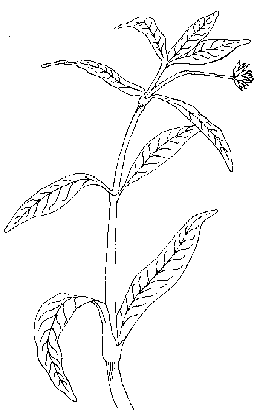
Scientific Name - Alternanthera philoxeroides
Common Name: Alligatorweed/Gator Grass
Distribution and Habitat
Alligator weed occurs in the piedmont and coastal plain of South Carolina. It is a very aggressive plant and will grow where wet or moist conditions exist. It often forms dense mats which impair access and use of a water body. Although this plant readily occurs throughout the state, it is not a native species.
Description
Alligator weed is a creeping vine-like plant whose stem may reach 4 feet in length. The leaves and ends of the stems are generally emergent but lower portions of the stem may be submerged, where they root extensively. These stems are hollow, ¼ inch or less wide and vary from dark green to pink or dull reddish-purple. The leaves of alligator weed are located opposite one another on the stem. Mature leaves are elongate, lance-shaped and may be up to one inch wide and four inches long. Those growing on stem ends are smaller and more elliptic in shape. This plant produces a small, white flower, which closely resembles that of clover. These flowers are located on spikelets that arise from the leaf base. Alligator weed spreads by seed production and by fragmentation of the plant.
Recommended Control Methods
1. *Rodeo:
Active Ingredient: Isopropylamine Salt of Glyphosate
Product Name: Rodeo
Approximate Cost: $110.00 - $125.00/gallon
Application Rates: 6 pints/acre as a broadcast spray or as a 1 ¼ percent
solution with hand-held sprayer.
Mixing rates for 1 ¼ percent spray solution:
| Desired Volume | Amount of Rodeo |
|---|---|
| 1 gallon | 1.60 ounce (2 tablespoons = 1 oz.) |
| 25 gallons | 1.25 quarts |
| 100 gallons | 5.00 quarts |
| *Manufacturer lists this product as a partial control agent | |
This product should be used with an approved surfactant at a rate of 1.0 - 1.5 quarts surfactant per 50 gallons of spray mix. Recommended surfactants include: Agri-Dex, Induce, LI-700, Liqua-Wet, Ortho Spreader 77, Passage, R-11, Super Spreader 200, Widespread
Application Methods and Tips:
Successful use of Rodeo is dependent on contact of the herbicide with the plant foliage, therefore do not apply this herbicide to submerged vegetation. Do not apply the product when rain is likely within 12 hours post-treatment. Best results are achieved when treatments are made when most of the plants are in bloom. Coverage should be uniform and conducted on a spray-to-wet basis. Repeat applications will be required to maintain control of alligator weed. READ AND FOLLOW THE HERBICIDE LABEL
Consult the fisheries biologist serving your county or more details concerning use of these products.
2. Sterile Grass Carp (White Amur)
Grass carp are not considered an effective alternative for the control of alligator weed.The above information is available as a downloadable PDF - Alligatorweed