

Lake Murray Aquatic Plant Management
Grass Carp Stocking
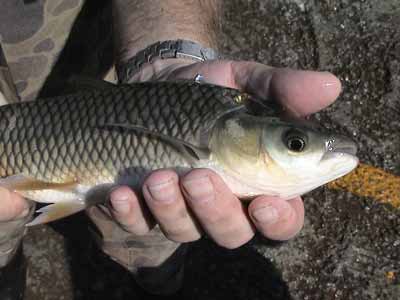
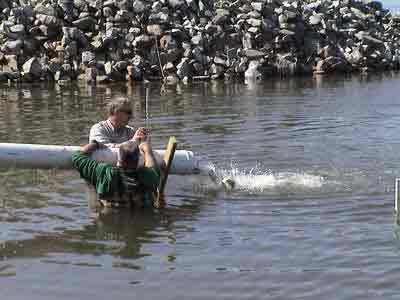 Between April and June 2003,
64,500 sterile grass carp were released at nine different locations
around Lake Murray to help control the growth of hydrilla. While
this control method should provide many years of lake-wide control,
initial results are not expected for about three years. Check out the
link below to see a map of the stocking sites!
Between April and June 2003,
64,500 sterile grass carp were released at nine different locations
around Lake Murray to help control the growth of hydrilla. While
this control method should provide many years of lake-wide control,
initial results are not expected for about three years. Check out the
link below to see a map of the stocking sites!
 Map of sterile grass carp
introductions.
Map of sterile grass carp
introductions.
 Surveys in the fall of 2003
indicated approximately 3,880 acres of hydrilla in the lake. The
reduction in coverage from 2002 (6,700 acres) was primarily due to the
lake drawdown for construction of the backup dam. Hydrilla did not
appear to spread to new locations or into deeper water during the
year.
Surveys in the fall of 2003
indicated approximately 3,880 acres of hydrilla in the lake. The
reduction in coverage from 2002 (6,700 acres) was primarily due to the
lake drawdown for construction of the backup dam. Hydrilla did not
appear to spread to new locations or into deeper water during the
year.
Hydrilla Coverage Map 2003
As water levels rose in 2004 surveys indicated that further reductions in hydrilla coverage had occurred on Lake Murray. The survey indicated that there was approximately 2600 acres of hydrilla currently in the lake. Areas around Dreher Island showed little or no hydrilla growth.
Since 2005 late season (October) surveys
showed no appreciable amount of Hydrilla to be found.
Several areas in the upper half of the lake were plagued with severe water primrose problems in the early
months of the summer of 2005 but as the season progressed some primrose
succumbed to the rising waters and became less problematic. Water primrose is normally a shoreline
species that does not grow well in deeper water and the thought is
that as the water stays at normal levels the primrose problems will
decrease.
For More Information Contact:
SCE&G |
SCDNR |