
Why Manage Invasive Species
Management decisions based on science have made plant management against invasive species now an essential function of government. Refusal by plant managers to allow hydrilla or other invasives to become the dominant aquatic plant in the state is not just for the benefit of homeowners and industry, but also for the benefit of our native aquatic plants and other native animals, for the benefit of our aquatic ecosystems as a whole, and for the benefit of our hunters, fishermen and recreational outdoorsmen.
What are Invasive (Nuisance) Aquatic Plants and Why are They a Problem?
Invasive non-native aquatic plants are those which have the potential to hinder the growth of beneficial aquatic plants, to interfere with flood control, irrigation or navigation, or to adversely affect the public welfare or the natural resources of this state. Some of the more common invasive aquatic plants in South Carolina include hydrilla, water hyacinth, giant salvinia, water primrose, phragmites, and alligatorweed. While aquatic plants are an important and beneficial part of lakes and rivers, some water plants, especially invasive non-native species that lack natural predators and diseases to keep their growth in check, can develop large nuisance populations. Some species have such a high potential for producing nuisance populations that they have been made illegal to transport or possess.
What is Being Done?
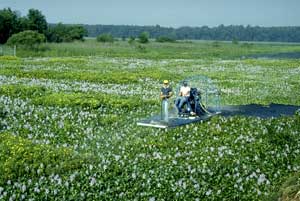 Nuisance aquatic plant populations are being managed using an integrated management approach to prevent them from reaching problematic levels. Integrated management utilizes biological, chemical and manual control techniques to maintain control of various nuisance and invasive species. At the same time efforts are made to minimize negative impacts on native vegetation. In certain instances, native plant communities are extended into areas with no vegetation through direct plantings. Decades of experience and many years of technical research have taught the SCDNR-ANS that maintaining noxious aquatic weed species at low levels is the most environmentally sensitive method for managing our serious invasive aquatic weed problems.
We've learned that management:
- Reduces the environmental impact of noxious weed species;
- Allows greater use of our waters;
- Uses less herbicide;
- Greatly reduces the overall costs;
- Creates greater biodiversity; and
- Promotes public confidence and cooperation.
Wildlife, Waterfowl, and Fish Need Aquatic Plants:
Misconceptions have developed over the years, based on erroneous information, as to what types of aquatic plants are beneficial to all wildlife. A prime example of this is the information that is spread about ducks. For thousands of years, ducks and other migratory water birds have come through South Carolina as temperatures drop in the northern United States and Canada. They fed on eelgrass (Vallisneria), pondweeds (Potamogeton), duck potatoes (Sagittaria) and other plentiful, native, aquatic plants.
Then, in the 1970s non-native hydrilla (Hydrilla verticillata) was introduced and invaded several of South Carolina’s lakes and rivers, quickly displacing and greatly reducing the abundance of eelgrass, pondweeds, duck potatoes and other plant duck foods.
During that period of time, with hydrilla on the increase and ducks having to consume hydrilla instead of preferred native plants, confusion has developed among duck hunters and others about the value of hydrilla to ducks.
Ducks eat a variety of wetland plants and their diets change according to what food is available. When a historic duck lake has been taken over by hydrilla, and there is no other convenient plant food available, ducks will eat hydrilla leaves, turions and tubers. But this does not mean that ducks prefer hydrilla, or that hydrilla should be allowed to grow unchecked for the "benefit" of ducks.
Wetland plant matter is very important to the diets of American wigeon, ring-necked ducks, redheads, gadwalls, rails, mallards, pintails, wood ducks, canvasbacks, whistling ducks, green- and blue-winged teal, coots, moorhen, soras, Canada geese, snow geese, and others.
Among the native aquatic plants that are especially important to wildlife, fish, ducks and other water birds in South Carolina are:
- the submersed plants of these genera: Ceratophyllum, Chara, Najas, Potamogeton, Ruppia, Utricularia, and Vallisneria;
- the tallish emersed plants of these genera: Carex, Cladium, Cyperus, Distichlis, Echinochloa, Eleocharis, Eriocaulon, Fimbrystilis, Juncus, Leersia, Panicum, Paspalum, Polygonum, Pontederia, Rhynchospora, Sacciolepis, Scirpus, Spartina, Typha, Xyris, Zizaniopsis, and Zizania;
- and the floating and floating-leaved plants of these genera: Brasenia, Lemna, Nelumbo, Nymphaea, Spirodela, and Wolffia.
Additionally, there is also a common perception among anglers that aquatic plant managers kill off aquatic plant species within an area without regard to fisheries. This is not true.
It's true that effects of some invasive aquatic plants are beneficial to fish in some ways especially early in the infestation. As do native plants, non-native invasive plants provide surface area for algae and small animals to attach to and live on: this is fish food. As do native plants, non-native invasive plant infestations provide room for baby fish to hide from predators.
And as do native floating plants, non-native floating invasive plants provide the "edge effect", a place where fish are more likely to be caught. And vast stands of hydrilla or mats of water hyacinth concentrate fish into a smaller area of open water, especially along the edges, causing the "reef effect" which attracts fish and increases the likelyhood of catching them.
However, fisheries research and closer analysis also reveals that invasive plant infestations beyond a certain extent actually stunt the growth of fish. Research shows that sometimes there may be more fish in a hydrilla infestation, but they'll be smaller fish.
Also, invasive plant infestations make it difficult to catch fish: try dragging a lure through hydrilla; try tossing a hook into a 10-50 acre mat of water hyacinth.
The Bottom Line:
Native plants are just as able to provide the same beneficial functions as do the invaders, and native plants have provided these benefits for eons before the invaders came.
For example, eel grass, pondweeds, bladderwort, the submersed sagittarias and others are some native plants that provide underwater plant surface area for fish food (those periphyton and small animals that attach to plant parts).
Native plants also oxygenate the water. And native plants are eaten by birds and fish, just as hydrilla is. Native plants on the other hand seldom fill the water column or form masses at the water surface, restricting navigation and recreation, creating low dissolved oxygen problems or creating flood control problems.
When non-native invasive aquatic plants are introduced and controlled early after they are discovered in a water body, they can be controlled at a low cost, protecting the integrity of the water body's native plant community. However, once established, managing invasive aquatic plants is extremely difficult given current technologies. Aquatic plant managers know this as do South Carolina lawmakers.
Sections include:
- Why Manage Invasive Species
- How Was the Program Established?
- Homeowner Information gives you the do's and don't