CONTENTS

Introduction
The South Atlantic Bight
Methods
Octocoral Morphology

Glossary
Gorgonacean Bauplan

List of Species

Occurence Table

Key to the Families of Octocorals in the South Atlantic Bight

Key to the Species of
Clavulariidae
Anthothelidae

Plexauridae
Gorgoniidae
Virgulariidae

Notes on the Species
Carijoa riisei
Scleranthelia rugosa
Telesto fruticulosa
Telesto nelleae
Telesto sanguinea
Bellonella rubistella
Pseudodrifa nigra
Nidalia occidentalis
Iciligorgia schrammi
Diodogorgia nodulifera
Titanideum frauenfeldii
Muricea pendula
Thesea nivea
Bebryce grandis
Bebryce parastellata
Scleracis guadalupensis
Placogorgia
sp.
Leptogorgia hebes
Leptogorgia punicea
Leptogorgia cardinalis
Leptogorgia virgulata
Leptogorgia setacea
Leptogorgia euryale
Ctenocella (Ellisella) barbadensis
Renilla reniformis
Sclerobelemnon theseus
Stylatula elegans
Virgularia presbytes

References Cited

Suggested Reading/Viewing

Acknowledgements

Family Alcyoniidae

Bellonella rubistella (Deichmann, 1936)

Alcyonium rubistella Deichmann, 1936:49-50, pl. 1fig. 2, pl. 3 figs. 1-7.

Remarks. This species is the only member of the Alcyoniidae that is found in the shallow South Atlantic Bight and typically inhabits deeper areas. This work represents the first record of Bellonella rubistella in the SAB.
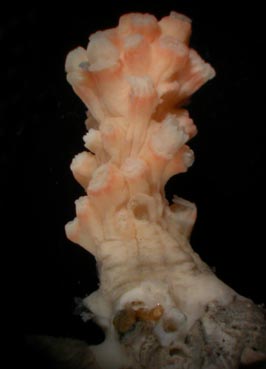
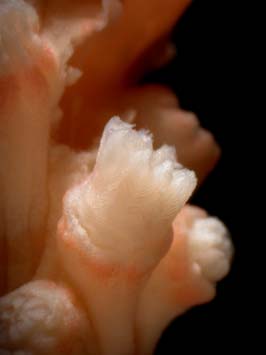
The colony from the SAB examined here is smaller than the USNM specimens from more southern or tropical localities. The colony is unbranched and attached to a piece of rock. The base is 8 mm wide and total length is 17 mm. The calyces are more crowded at the tip but the stalk near the base is sterile. The calyces are 1.5 mm in diameter and appear light pink around the tips, when contracted have eight lobes which develop into eight grooves along the body wall. Partially exert anthocodia have a crown of spindles arranged en chevron. The coenenchyme is ivory.
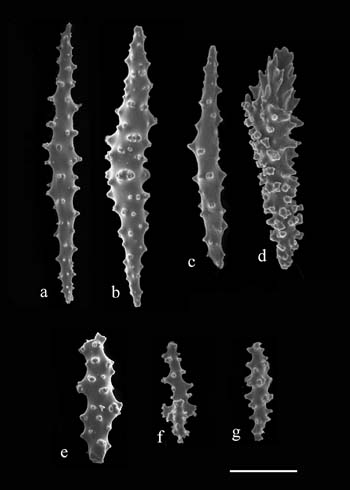
The stalk bears sclerites in the form of elongate acute spindles, slightly flattened, with tubercles, up to 0.3 mm in length. The calyces contain sclerites as elongate spindles, some curved, 0.2-0.5 mm in length, and some club-like spindles and small (< 0.1 mm) radiates. Most spindles are white with pink rods occurring occasionally.
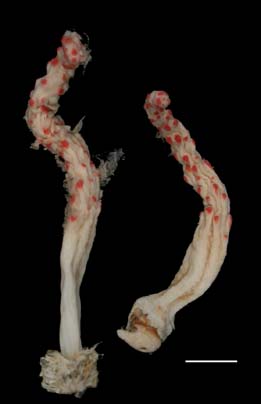
Other colonies from tropical regions are recorded as having a digitiform shape that narrows distally to more or less a point, and bright red calyces (Verseveldt, 1978). The examined specimen more closely resembles the figure in Deichmann (1936) than those in Verseveldt (1978).

Atlantic distribution: South Carolina, Florida, Caribbean, Colombia to Venezuela, 24-366 m (Deichmann, 1936; Verseveldt, 1978; Verseveldt and Bayer, 1988; NMNH collections; SERTC collection).

Bellonella rubistella (S2363) sclerites. a) needle from anthocodia; b-g) spindles from coenchyme
Figure 3. Bellonella rubistella (S2363) sclerites. a) needle from anthocodia; b-g) spindles from coenenchyme. Scale bar = 100 µm.


Bellonella rubistella, preserved specimen (S2363, colony height = 17mm)
Figure 1. Bellonella rubistella, preserved specimen (S2363, colony height = 17mm).

Bellonella rubistella (S2363), showing crown.
Figure 2. Bellonella rubistella (S2363), showing crown.

Bellonella rubistella, preserved specimen (USNM 55376) from Venezuela, showing red calyces
Figure 4. Bellonella rubistella, preserved specimen (USNM 55376) from Venezuela, showing red calyces. Scale bar = 1 cm.

Back to SERTC