CONTENTS
Introduction
The South Atlantic Bight
Methods
Octocoral Morphology
Glossary
Gorgonacean
Bauplan
see this for keys
Notes on the Species
Carijoa
riisei
Scleranthelia
rugosa
Telesto fruticulosa
Telesto nelleae
Telesto sanguinea
Bellonella rubistella
Pseudodrifa nigra
Nidalia occidentalis
Iciligorgia schrammi
Diodogorgia
nodulifera
Titanideum
frauenfeldii
Muricea pendula
Thesea nivea
Bebryce cinerea
Bebryce parastellata
Scleracis guadalupensis
Paramuricea sp.
Leptogorgia hebes
Leptogorgia punicea
Leptogorgia
cardinalis
Leptogorgia virgulata
Leptogorgia setacea
Leptogorgia euryale
Viminella
barbadensis
Renilla reniformis
Sclerobelemnon
theseus
Stylatula elegans
Virgularia presbytes
| Guide
to the Shallow Water (0-200 m) Octocorals of the South Atlantic
Bight.
S. T. DeVictor
& S. L. Morton, 2007
Telesto nelleae Bayer,
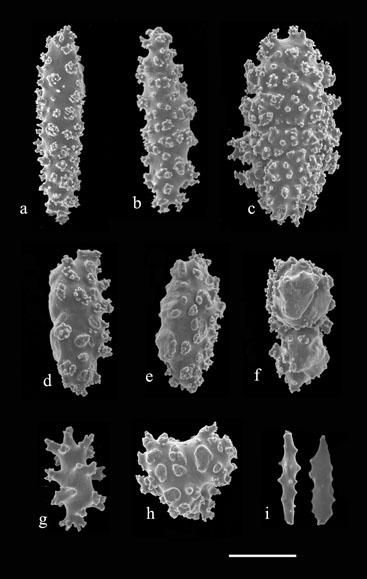
1961 Remarks. Telesto nelleae is similar to T. fruticulosa, but can be distinguished by the presence of elongate, spindle-like sclerites in the coenenchyme, and the presence of a sparse cluster of flat rods restricted to the base of the tentacles. Granular and branching sclerites in addition to the elongate spindles are present in the coenenchyme. The color of the colony is yellowish brown when preserved in ethanol. Atlantic distribution: North Carolina, 27-227 m; Cuba, 210-298 m; Bahamas, 1153 m (Bayer, 1961; NMNH collections).
|
Figure 2. Telesto nelleae sclerites (USNM 61225); a-c) spindles from calyx wall; d-f) granular sclerites from calyx walls; g, h) sclerites from body wall; i) flat rods from polyp tentacle (scale bar = 100 µm). |
_sm.jpg "Telesto nelleae, preserved specimen (USNM 50703, holotype)")
 |