|
Family Ellisellidae
Ctenocella (Ellisella)
barbadensis (Duchassaing
& Michelotti, 1864)
Juncella barbadensis Verrill, 1864:22. pl.
5 figs. 5-6.
Remarks. The specimens examined
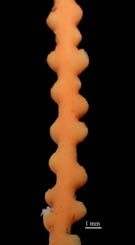
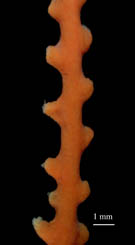
for this work do not exhibit the large diameter and crowded calyces
discussed in Bayer (1961), but variability of these characters has
been noted (Deichmann, 1936). The SERTC and USNM colonies are all
unbranched, slender colonies (1–2 mm exclusive of calyces)
with calyces arranged biserially in a row on each side in a somewhat
alternating pattern. The calyces are very prominent and sometimes
upturned, except in a few areas where the coenenchyme appears ‘inflated’
and the calyces are reduced in prominence. The color of the preserved
colonies varies from pale to deep orange, with a solid, white core.
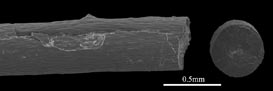
As is diagnostic of this family, the calcified axis exhibits a radial
pattern in cross section. In some cases where the calyces are not
as prominent, the slender colonies of C. barbadensis may
resemble colonies of Leptogorgia euryale or L. stheno;
microscopic examination of the axis characteristics and absence
of red spindles will readily distinguish C. barbadensis
from members of the Gorgoniidae.
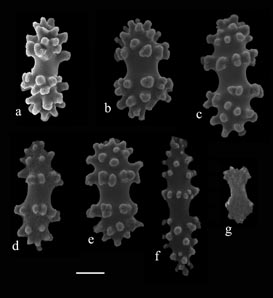
The sclerites examined from the tip of the USNM specimen are dominated
by amber, tuberculated double heads, double cones and warty rods.
Other specimens examined contain double heads that are more coarsely
tuberculated, perhaps a function of the location of the subsample
on the colony. Many of the double-headed sclerites have a notable
degree of granulation on the tips of the tubercules. As is typical
with this genus, the largest double cones or spindles are no more
than twice the length of the double heads.
This species can reach a very large size in some parts of the tropical
Atlantic, reaching a few meters in length and almost a centimeter
in diameter.
Note: A small ellisellid fragment was found among
a lot of Leptogorgia specimens and was tentatively identified
as Ctenocella (Ellisella) cf. schmitti
(O. Breedy, pers. comm.). The fragment is too small to reveal the
characteristic branching of this species, thus precluding the addition
of C. schmitti to this guide. Although there are no records
of C. schmitti occurring north of Boca Raton, Florida (approximately
26°22’ N), the presence of C. schmitti in the
shallow South Atlantic Bight is possible.
Atlantic distribution: South Carolina to Brazil,
Gulf of Mexico, Caribbean, 12-453 m (Deichmann, 1936; Bayer, 1961;
NMNH collections; SERTC collection).
|
 
Figure 1. Ctenocella (Ellisella) barbadensis, preserved
specimens (S2629), sections of colony stem (scale bars = 1 mm respectively)

Figure 2. Solid axis of Ctenocella (Ellisella)
barbadensis (USNM 50395, scale bar = 0.5mm).

Figure 3. Sclerites of Ctenocella (Ellisella)
barbadensis (USNM 50395); a-e)double heads from coenenchyme;
f) flattened double cone from calyx; g) small flattened rod from
polyp (scale bar = 20 µm).
|