CONTENTS
Introduction
The South Atlantic Bight
Methods
Octocoral Morphology
Glossary
Gorgonacean
Bauplan
see this for keys
Notes on the Species
Carijoa
riisei
Scleranthelia
rugosa
Telesto fruticulosa
Telesto nelleae
Telesto sanguinea
Bellonella rubistella
Pseudodrifa nigra
Nidalia occidentalis
Iciligorgia schrammi
Diodogorgia
nodulifera
Titanideum
frauenfeldii
Muricea pendula
Thesea nivea
Bebryce cinerea
Bebryce parastellata
Scleracis guadalupensis
Paramuricea sp.
Leptogorgia hebes
Leptogorgia punicea
Leptogorgia
cardinalis
Leptogorgia virgulata
Leptogorgia setacea
Leptogorgia euryale
Viminella
barbadensis
Renilla reniformis
Sclerobelemnon
theseus
Stylatula elegans
Virgularia presbytes
| Guide
to the Shallow Water (0-200 m) Octocorals of the South Atlantic
Bight.
S. T. DeVictor
& S. L. Morton, 2007
Scleranthelia rugosa
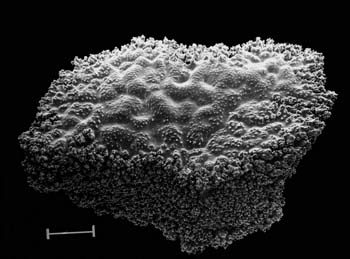
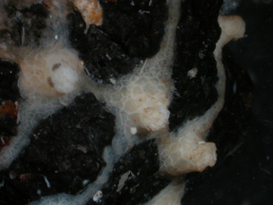
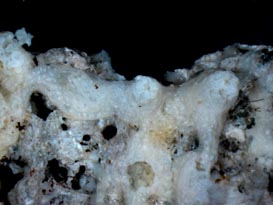
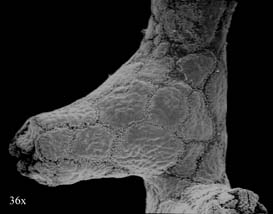
(Pourtalès), 1867 Sarcodictyon rugosum, Pourtalès , 1867:113. var. musiva Studer, 1878 Scleranthelia musiva Studer, 1878b:634, Plate 1 fig. 4 Remarks. This octocoral is the only encrusting species recorded in the SAB. The two growth forms of Scleranthelia rugosa differ mainly in the expanse of the stolon between calyces. Growth form rugosa resembles a “network” of individual calyces interconnected by band-like stolons (up to 2 mm in width), whereas form musiva may encrust dead octocoral axes, shells or substrate with more sheet-like coenenchyme. Both forms have colorless sclerites mainly in the form of large (up to 1 mm) flat plates that fit closely together in mosaic fashion, and somewhat cylindrical calyces that widen near the base, taking the shape of a cone. Thorny stars and rods are present in the anthocodiae. The rugosa specimen examined for this work was encrusted on a dark rock which made the translucent white coenenchyme very visible, but the musiva specimen was encrusted on a piece of pale shell hash and was well camouflaged. Bayer (1981b) did not recognize these two forms as separate species but they are cataloged in the USNM as such. This species is probably not found within typical SCUBA diving limits. The S. rugosa growth form rugosa specimen examined for this work was collected via manned submersible. Atlantic distribution: form rugosa - South Carolina to Martinique, Guyana, 100-550 m; form musiva – New York to Guyana, Gulf of Mexico, Caribbean, 70-300 m (type recorded off Havana at 493 m) (Deichmann 1936; Bayer, 1981(b); NMNH records).
|
|
 |