CONTENTS
Introduction
The South Atlantic Bight
Methods
Octocoral Morphology
Glossary
Gorgonacean
Bauplan
see this for keys
Notes on the Species
Carijoa
riisei
Scleranthelia
rugosa
Telesto fruticulosa
Telesto nelleae
Telesto sanguinea
Bellonella rubistella
Pseudodrifa nigra
Nidalia occidentalis
Iciligorgia schrammi
Diodogorgia
nodulifera
Titanideum
frauenfeldii
Muricea pendula
Thesea nivea
Bebryce cinerea
Bebryce parastellata
Scleracis guadalupensis
Paramuricea sp.
Leptogorgia hebes
Leptogorgia punicea
Leptogorgia
cardinalis
Leptogorgia virgulata
Leptogorgia setacea
Leptogorgia euryale
Viminella
barbadensis
Renilla reniformis
Sclerobelemnon
theseus
Stylatula elegans
Virgularia presbytes
| Guide
to the Shallow Water (0-200 m) Octocorals of the South Atlantic
Bight.
S. T. DeVictor
& S. L. Morton, 2007
Titanideum frauenfeldii
(Kölliker, 1865) Remarks. Titanideum frauenfeldii is a very common species occupying hardbottom habitats in the SAB. The colonies are moderately branched (or unbranched if small), with stiff, cylindrical, rod-like branches reaching 8 mm in diameter. The coenenchyme may appear smooth, slightly indented, or have slightly protruding polyp mounds. They vary from yellow to deep red in color. The ring of boundary canals separating the cortex and medulla is typical of this family and is generally very apparent when examining the branch in cross section. Also present is a layer of solenia, which divides the cortex into two layers— a thin, densely spiculated outer cortex and a thick, spongy inner cortex. The cortical sclerites consist of variable pink tuberculated spheroids and tuberculated branched bodies, and the medulla is filled with densely packed, colorless branching rods, most of which are oriented longitudinally. Atlantic distribution: North Carolina to Cuba, north Gulf of Mexico, 13-293 m (Deichmann, 1936; Bayer, 1961; NMNH collections; SERTC collections). |
|
|
| Figure 3. Titanideum frauenfeldii sclerites (S2658); a-e) radiate bodies from cortex (scale bar = 20 µm); f, g) small radiate bodies from cortex (scale bar = 10 µm); h-j) branching rods from medulla (scale bar = 50 µm). | ||
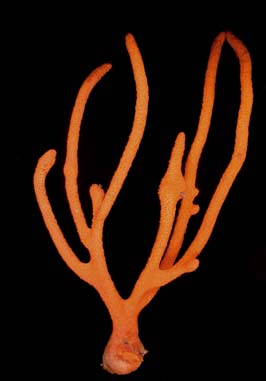
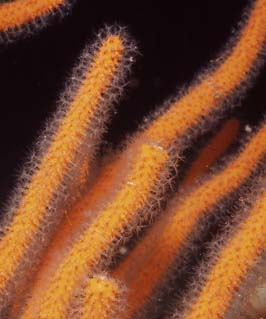 Figure 2. Titanideum frauenfeldii (in situ),
showing expanded polyps.
Figure 2. Titanideum frauenfeldii (in situ),
showing expanded polyps. 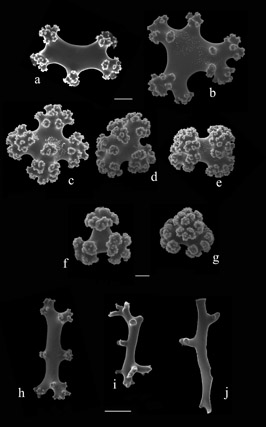
 |