CONTENTS
Introduction
The South Atlantic Bight
Methods
Octocoral Morphology
Glossary
Gorgonacean
Bauplan
see this for keys
Notes on the Species
Carijoa
riisei
Scleranthelia
rugosa
Telesto fruticulosa
Telesto nelleae
Telesto sanguinea
Bellonella rubistella
Pseudodrifa nigra
Nidalia occidentalis
Iciligorgia schrammi
Diodogorgia
nodulifera
Titanideum
frauenfeldii
Muricea pendula
Thesea nivea
Bebryce cinerea
Bebryce parastellata
Scleracis guadalupensis
Paramuricea sp.
Leptogorgia hebes
Leptogorgia punicea
Leptogorgia
cardinalis
Leptogorgia virgulata
Leptogorgia setacea
Leptogorgia euryale
Viminella
barbadensis
Renilla reniformis
Sclerobelemnon
theseus
Stylatula elegans
Virgularia presbytes
| Guide
to the Shallow Water (0-200 m) Octocorals of the South Atlantic Bight.
S. T. DeVictor
& S. L. Morton, 2007
Carijoa riisei
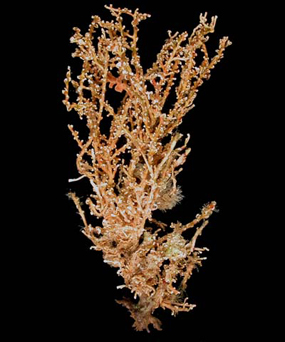
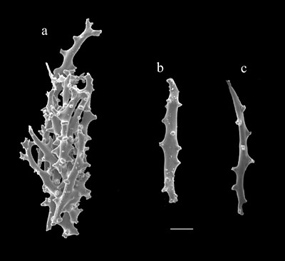
(Duchassaing and Michelotti, 1860) Remarks. Carijoa riisei is considered a fouling organism. The colonies are densely branching, often having a large, bushy appearance, and are white or pale when preserved. The cylindrical calyces of the primary polyps and daughter polyps have eight longitudinal grooves. Specimens of C. riisei are distinguished easily from other branched SAB clavulariids by the sclerites, which are branching, thorny rods and spindles, as opposed to granular bodies of T. sanguinea, T. fruticulosa and T. nelleae. There is some weak fusion of thorny rods. The polyps bear sparse spiculation in the form of small rods, which are located in the polyp bases and basal regions of the mesenteries. Atlantic distribution: South Carolina to Brazil, Gulf of Mexico, Caribbean; low tide line to 104 m (NMNH records indicate a specimens collected from 309 m off Havana, Cuba, and from 732 m off the Florida Keys; Deichmann (1936) noted a colony from St. Lucia collected from 508 m). (Deichmann, 1936; Bayer, 1961; NMNH collections; SERTC collection). |
|
 |