CONTENTS
Introduction
The South Atlantic Bight
Methods
Octocoral Morphology
Glossary
Gorgonacean
Bauplan
Key to the Families of Octocorals in the South Atlantic Bight
Key to the Species of
Clavulariidae
Anthothelidae
Plexauridae
Gorgoniidae
Virgulariidae
Notes on the Species
Carijoa
riisei
Scleranthelia
rugosa
Telesto fruticulosa
Telesto nelleae
Telesto sanguinea
Bellonella rubistella
Pseudodrifa nigra
Nidalia occidentalis
Iciligorgia schrammi
Diodogorgia
nodulifera
Titanideum
frauenfeldii
Muricea pendula
Thesea nivea
Bebryce grandis
Bebryce parastellata
Scleracis guadalupensis
Placogorgia sp.
Leptogorgia hebes
Leptogorgia punicea
Leptogorgia
cardinalis
Leptogorgia virgulata
Leptogorgia setacea
Leptogorgia euryale
Ctenocella (Ellisella)
barbadensis
Renilla reniformis
Sclerobelemnon
theseus
Stylatula elegans
Virgularia presbytes
| Key to Families of Shallow Water (0-200m) Octocorals of the South Atlantic Bight Order Alcyonacea- Couplet 2 |
|
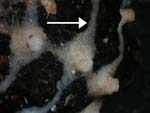
| 2a.
– Encrusting colonies, or branching colonies with terminal
primary polyp and budded lateral daughter polyps arising from sheet-like, ribbon-like, or reticulating stolons. Calyces long, cylindrical,
with retractable polyps
|
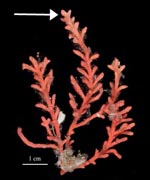
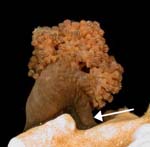
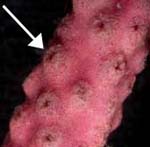
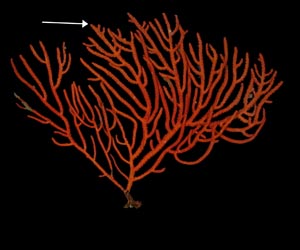
2b. – Colonies not encrusting; possessing a shared, fleshy coenenchyme and/or a membranous or fleshy stalk or base. Colonies without a primary or terminal polyp from which all daughters arise. Calyces spiky, dome-like, flush, or cylindrical, but not long..................3
|
 |